IA en un minutoNewsBusiness and products
AlphaGo co-creator Thore Graepel launches Metis Reasoning, a “compute-efficient” AI company in London
IA en un minuto newsroom · Editor: Jon Elgezabal
In 30 seconds
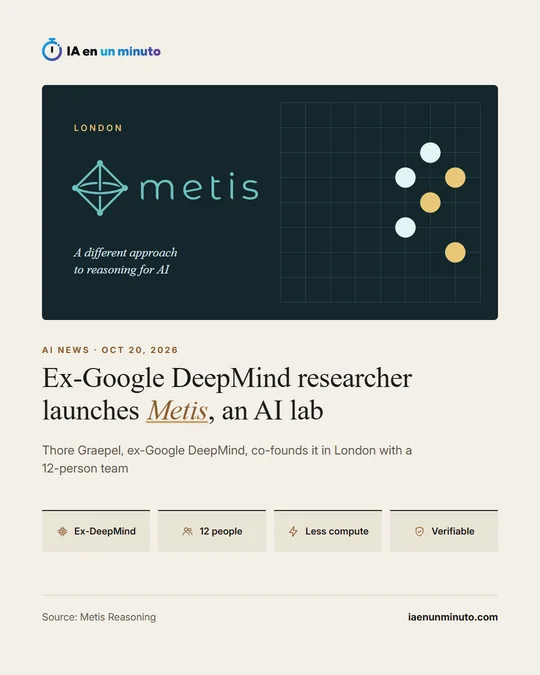
Thore Graepel, who helped create AlphaGo and left Google DeepMind this summer, has set up Metis Reasoning in London, which starts out with a 12-person team. Metis proposes machine reasoning that uses less compute and leaves traces that can be checked, inspired by the architecture of AlphaGo. There is no date yet for its first model.
Thore Graepel, one of the creators of AlphaGo, the Google DeepMind program that made history by beating human Go players, has co-founded Metis Reasoning, a London-based artificial intelligence company that is being unveiled today, Tuesday, October 20. Graepel left Google DeepMind this summer.
According to Tech.eu, Metis wants to open an alternative, “compute-efficient” path to the most advanced models from OpenAI and Anthropic. Its team has 12 people: researchers, mathematicians, robotics specialists and entrepreneurs. Graepel's co-founders are Piers Ingram, who has founded several technology and biotech companies and brought in over $350 million in funding; Michael Warren, a specialist in robotics and autonomous systems who worked at Boeing; and David Berman, who heads AI at Cambridge Consultants and advises the UK government and NATO on AI. The name comes from Metis, the Greek goddess of wisdom.
The company acknowledges that large language models have come a long way, but argues that their reasoning is unreliable and leaves no trail that can be audited, and that this holds back their use in many sectors because their work is hard to verify. Its approach carries an architectural lesson from AlphaGo over to reasoning and, according to the company, is more verifiable, more robust and safer than today's models. In its white paper, signed by the four founders, it describes a system that learns reasoning strategies, accepts a claim only when the evidence backs it and leaves auditable reasoning traces. Metis believes its approach suits sectors such as robotics and engineering.
Ingram told Tech.eu that its architecture is “much much more compute-efficient” than frontier models and that Metis has obtained “encouraging” results on advanced reasoning problems for a fraction of what those models cost. The same outlet says the company is believed to be initially seeking tens of millions of dollars; Ingram declined to comment on those reports, saying only that it has been able to fund Metis “more than adequately” so far.
It is not yet known when Metis will publicly release its first model. It joins other new AI companies born in London, such as Ineffable Intelligence, set up by David Silver, who worked with Graepel on AlphaGo, and Recursive Superintelligence, whose co-founders include the German computer scientist Richard Socher.
Why it matters · analysis and opinion
The arrival of Metis confirms that some of the talent behind AI's great milestones no longer believes the way forward lies only in training ever larger models. If its approach works, reasoning that can be audited would open the door to sectors where an unjustified answer is useless, such as engineering or robotics. For now, though, these are promises: there is no public model, no independent testing and no pricing, and the results it cites come from the company itself. For anyone choosing AI tools at their company, the useful question this news leaves is a different one: whether their current provider can explain how it reaches each answer, because that traceability is starting to become a selling point.
Source: Tech.eu · Written with the help of AI: how we make the news