Anthropic uses Claude, its AI model, to prove security properties in 123 open-source libraries
IA en un minuto newsroom · Editor: Jon Elgezabal
In 30 seconds
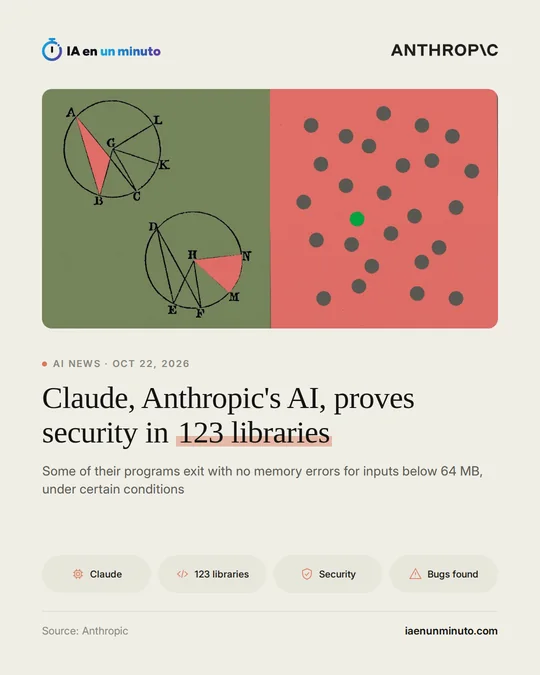
Claude, Anthropic's model, has used mathematics to show that part of the code in 123 open-source libraries does not crash from memory errors. The work, done with Theorem on the processor's RISC-V instructions, holds as long as the input stays under 64 MB and certain conditions are met. While it worked, bugs that had stayed hidden for years came to light, and part of the proofs is being released so others can review them.
On Thursday, October 22, Anthropic released research carried out with Theorem in which Claude, its AI model, applied formal verification (mathematically proving that a program follows a set of rules) to 123 open-source libraries. According to the company, it is the first large-scale attempt to use AI for this on production software, working at the level of RISC-V assembly code (the instructions the processor actually runs).
The starting point was the fuzz tests (the kind that hammer a program with altered inputs to make it fail) that these libraries keep in Google's OSS-Fuzz. Claude proved that some of their programs always exit normally, with no memory-safety errors, for any input below 64 MB and under certain conditions: that they run on a single thread, on a RISC-V processor with Linux and with a fixed memory limit. Within a few weeks it achieved this for 239 entry points of those tests, with proofs that add up to about 180 million lines in Rocq, the tool that checks them.
While writing the proofs, Claude found and fixed bugs that had gone unnoticed for years even after trillions of test runs. One, in a decompressor, only appeared with inputs of around 20 MB and a specific layout, a size fuzzers rarely try because they typically go no higher than 1 MB. It also rediscovered an already catalogued vulnerability in libexpat.
Until now, this technique took years of expert work and only paid off in critical systems such as Airbus's avionics software: building seL4, an operating system kernel, took two person-years, and verifying it took 20.
Anthropic is releasing part of the proofs, along with the RISC-V and Linux models they rely on, so that anyone can check them; it is holding back those that could reveal bugs not yet fixed. Theorem is offering to run the same process on other open-source projects and has released a Claude skill so developers can begin checking their own code.
The company acknowledges that it is still far from fixing every possible bug. The proofs do not cover every entry point in each library, and most users run these libraries on x86 or ARM chips rather than RISC-V. Cost is another limit: producing the proofs can consume hundreds of millions of tokens, although, according to Anthropic, its Opus 5.5 model uses roughly 40% fewer tokens than Opus 5 to solve half of 36 test tasks.
Why it matters · analysis and opinion
Proving that a program is free of a certain kind of bug was, until now, a luxury reserved for avionics and other critical systems. An AI doing it in bulk changes the security conversation: from hunting for errors by testing over and over to being able to guarantee in writing that certain errors do not exist. The move to everyday use has not happened yet. The proofs hold for a processor and a setup that are not the usual ones, consume a huge amount of computing power and do not cover entire libraries. For anyone who builds or buys software, the immediate benefit is a different one: simply attempting the proof uncovers bugs that standard testing misses. The things to watch are whether the method reaches the most common processors and whether the cost drops enough to move beyond large open-source projects.
Official source: Anthropic · Written with the help of AI: how we make the news