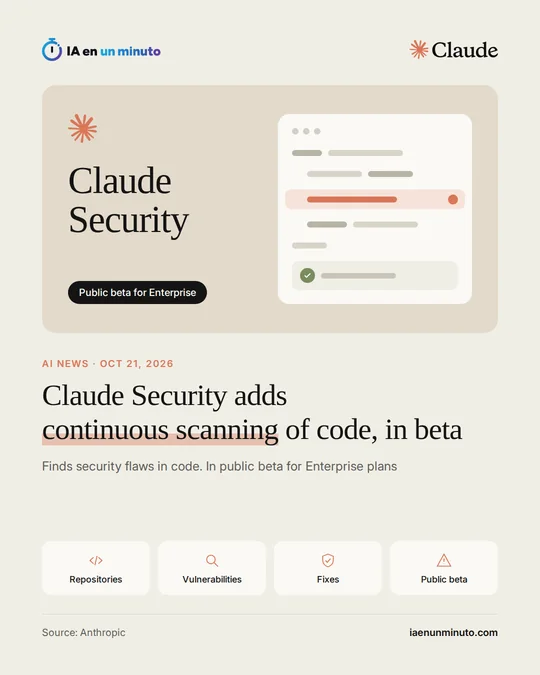
Anthropic adds continuous scanning and fix tracking to Claude Security, its tool for finding code vulnerabilities, in public beta for Enterprise
IA en un minuto newsroom · Editor: Jon Elgezabal
In 30 seconds
Claude Security no longer depends on someone launching each review: it watches repositories nonstop and flags the security problems that come with new changes. Anthropic has also added tracking of every flaw until its fix, an API and an MCP connector. The update, announced on October 21, can only be tried in public beta by Claude Enterprise customers.
On Wednesday, October 21, Anthropic announced a new version of Claude Security, the Claude capability that hunts for vulnerabilities in code. Rather than waiting for someone to kick off each scan, the tool now watches repositories continuously, follows every finding until it is fixed and takes into account what the team tells it about its setup. It is open as a public beta to Claude Enterprise customers.
Claude Security has been in public beta since April, and in that time thousands of organizations have relied on it to uncover more than a million vulnerabilities, according to Anthropic. It runs on the company's whole family of models, Claude Mythos included, and does not require access to its Cyber Verification Program.
According to the Claude Help Center, each project can link up to eight repositories: GitHub ones, GitHub Enterprise Server included, through the Claude app for GitHub, and those on GitLab, Bitbucket or other Git providers with an access token. Claude reads the code, drafts a threat model (a map of the project's risks) that the team can review and edit, and runs a first in-depth scan. After that, it reviews new changes at regular intervals depending on their risk and complexity, with no fixed schedule. Because a project can bring several repositories together, it can catch flaws that sit between services, such as a server that trusts data the client app was supposed to validate. Anthropic warns that running two scans on the same code can produce different results, because the agent adapts its reasoning on each pass.
When the fix reaches the code, Claude Security marks the finding as fixed, whether it was made in Claude Code or some other way, and reopens it if the problem comes back. Each finding comes with a severity level, weighed against the project's threat model, and an account of the route an attacker might take to the vulnerable code, sometimes illustrated with a diagram. From a finding, users can jump into a Claude Code session to generate a targeted patch, which a person then reviews. Each project also has a knowledge base where the team describes how its code is deployed and which security policies it follows.
The new version adds an API to query and manage projects and findings, webhook alerts when a new finding appears, an MCP connector to use it from Claude.ai and Claude Code, and role-based access controls to decide who creates projects and who sees or triages findings.
Users need an active Enterprise plan and a premium seat each, the organization must have usage credits turned on, and an owner switches the feature on. It is billed only at the direct cost of the tokens, with no platform fee, and it can have its own spend limit. As a launch offer, Enterprise organizations get up to $25,000 a month in free credits for two months, covering usage through December 31, 2026. Anthropic has not said when it will leave beta or whether it will reach other plans.
Why it matters · analysis and opinion
The real shift is in how it is used: a one-off review goes stale as soon as someone pushes new code, while continuous monitoring stays with the project and checks whether fixes actually land. That makes these tools look less like an occasional audit and more like a colleague working in the background. There are caveats: Anthropic itself warns that repeating a scan on the same code may not yield the same findings, the cost depends on usage and the feature is still in beta. For a company that builds its own software, the sensible move is to try it first on a limited repository, review by hand the threat model it generates, compare its findings with those of its current tools and set a spend limit before opening it up to more teams.
Official source: Anthropic · Written with the help of AI: how we make the news
What does it mean for your business? · analysis and opinion
For now, this update only reaches companies on a Claude Enterprise plan, and in public beta. Most small businesses and freelancers in Spain and Latin America who use Claude on other plans do not have access to it. Where it can fit is in development studios, small software companies or startups that already have that plan and maintain their own code on GitHub or another Git provider.
If that is your case, the prudent approach is to start with a small, non-critical project, connect only the repositories you need (the limit is eight per project) and assign roles carefully: full access for whoever will manage the project, and view-only access for everyone else. It is also worth reviewing and completing the threat model that Claude writes, and describing in the project's knowledge base how the code is deployed and who can reach it, because Claude uses that information to decide what to flag and how severe it is.
Our advice is to treat the suggested patches as what they are: suggestions that a person must review before merging them. Since it is in beta, it should not replace the security reviews already in place, but complement them. The main risk is opening all your code to an external tool, so it pays to decide beforehand which repositories go in and which stay out.