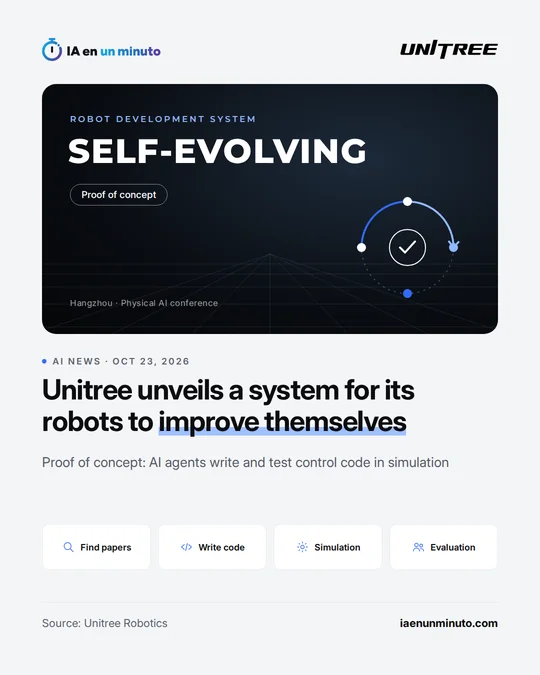
Unitree unveils a proof of concept in which AI agents write and test its robots' code
IA en un minuto newsroom · Editor: Jon Elgezabal
In 30 seconds
Unitree wants AI agents to look up research, program the control of its robots and rehearse it in simulation before handing it to real machines. Wang Xingxing named it Unitree Rehearsal and set it as the priority of the year. For now it is only a proof of concept: the models still fail when grasping and handling objects.
Unitree Robotics, the Hangzhou company best known for videos of its robots dancing, running and boxing, wants AI to take over much of what its engineers do now. Its founder, Wang Xingxing, laid out the plan on Thursday, October 22, in Hangzhou, at the physical AI conference the company organizes, as reported by Xataka and the South China Morning Post.
The project is called Unitree Rehearsal, and Wang presented it as a "self-evolving" robot development system. The idea is a closed cycle: AI agents find research papers, draft control code based on them, put it to the test and train it in simulation; whatever works best is checked before it moves on to real robots, and a separate evaluation system, with human input when needed, scores each result to decide whether it goes through to the next round. According to the South China Morning Post, Wang described it as the company's top project this year.
Wang's case for it is how slow it is today to teach a humanoid a new skill: engineers gather data, train models and adjust how the robot behaves, and something that goes well in the lab may have to be redone somewhere else. Back in August, at the World Robot Conference in Beijing, he had already argued that a drastic gain in development efficiency, and even robots that evolve on their own, were worth pursuing.
Unitree has been testing OpenAI's GPT-6 on its robots. Wang says that in internal experiments they carried out tasks such as painting or playing Go without specific training for them. In footage played during the conference, the robots used that model to work out routes and plan their movements, although it did not show how reliably they can repeat this in places they do not know.
For now it is a proof of concept. Wang himself admits that the models plan and find their way well but still make mistakes when manipulating objects, and that the hardest part is "aligning the AI model's inputs and outputs with those of a real robot". Stanford University's 2026 AI Index, cited by the SCMP, put robots' success rate on real household tasks at 12%, far below what they achieve in simulation.
As for timing, Wang believes that, if that hurdle is cleared, humanoids could tidy rooms as soon as 2027, although he sees 2028 as more realistic, and he hopes Unitree's robots will start reaching homes by the end of this year or next.
Why it matters · analysis and opinion
What is new is not that an AI writes code, but the attempt to close a robot's whole cycle with hardly any engineers: search, program, rehearse and evaluate. If it worked, the sector's bottleneck would stop being how many people write code and become how much real-world data is collected. But what Unitree has shown is its own demonstration, with no efficiency data or independent tests, and the weak spot its founder admits, handling objects precisely, is exactly what separates a show from useful work. Until there are results outside its lab, it reads better as a statement of direction from the manufacturer than as a capability on offer. For anyone following robotics, the signal is that the competition is no longer only about hardware, but about the software that trains it.
Source: Xataka · Written with the help of AI: how we make the news