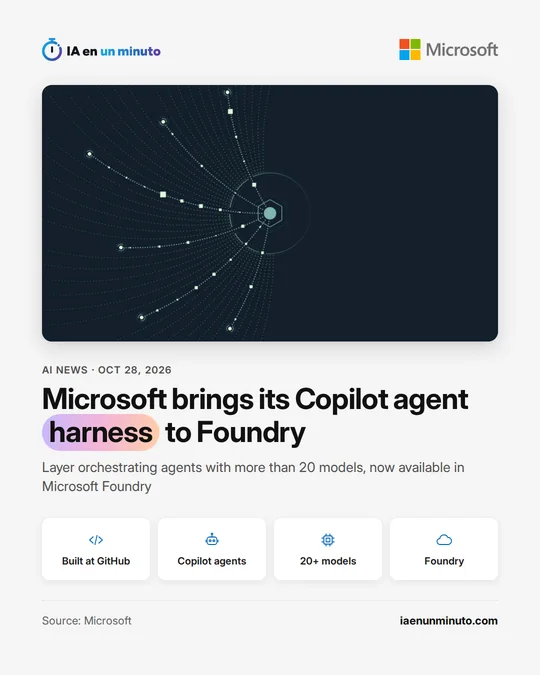
Microsoft offers the Copilot "harness", the layer that orchestrates its agents across multiple AI models, in Foundry
IA en un minuto newsroom · Editor: Jon Elgezabal
In 30 seconds
Microsoft is making available to developers and businesses, through Foundry, the framework that runs its own Copilot agents. GitHub created this layer to give the model instructions, context and controls, and it supports over 20 models or a team's own keys. Foundry lets teams download it as a development kit or launch it in the cloud, with Microsoft handling the management.
On October 28, Microsoft opened up to developers and businesses the piece that already runs its own Copilot agents. It is called the Microsoft Copilot harness, and it is the orchestration layer around the AI model that supplies instructions, context, an execution environment and controls, according to Microsoft's official blog.
It was created by GitHub's engineering team and Microsoft has adopted it across the company: it underpins Copilot Code, Copilot Studio, the GitHub Copilot app, the command line and VS Code, among others. In Copilot Studio it was previously known as the GitHub Copilot harness; according to the Copilot blog, the new name reflects its broader role, existing agents keep working the same way and neither capabilities nor billing change.
It is now available through Microsoft Foundry, the company's platform for building agents. The SDK (the development kit) can be downloaded, or the harness can be run in the cloud with Foundry managing it. In that second case, Microsoft takes care of the agent loop and the isolated execution sandbox, while the customer brings the instructions, skills, tools and choice of model. It supports open standards such as MCP and agent skills, and Microsoft says the platform stays open for using other harnesses and frameworks.
It works with more than 20 frontier models and accepts customers' own keys; Microsoft says it routes each task to the model or models best suited to it. The company also says it ported the runtime to Rust, with less overhead per session and a shorter time to first token.
In Microsoft's internal tests against its Standard harness, the new one raised pass rates on the same tasks by 10.8 percentage points with an OpenAI model and by 22.1 with an Anthropic one. After a failed tool call, agents kept trying in 84–91% of the evaluated cases, versus fewer than 7%, and the net cost of processing input fell by 15 to 21% despite nearly twice as many model calls. These are Microsoft's own figures, and it warns they may vary by day, build, model and configuration. A Microsoft support agent built on it resolved more than 35% of cases fully autonomously, without human intervention, in August 2026.
Neither post gives pricing or a country-by-country availability schedule.
Why it matters · analysis and opinion
Anyone who wanted an agent able to choose between several models had to build and maintain their own orchestration layer or their own model selector, a task Microsoft itself describes as slow and hard. Offering a piece already proven in its own products shifts the competition from the model to the system around it, and reduces the risk of being tied to a single provider when the best model changes. For a company that already builds agents with Copilot Studio or is trying out Foundry, it opens a path to move ahead without building that foundation. What remains to be known is the cost, because neither of the two posts mentions prices, and how far the improvements Microsoft cites, measured by Microsoft itself, hold up in the real tasks of each business.
Official source: Microsoft · Written with the help of AI: how we make the news