Anthropic says an unreleased Claude model wrote an exploit for a Linux kernel vulnerability
IA en un minuto newsroom · Editor: Jon Elgezabal
In 30 seconds
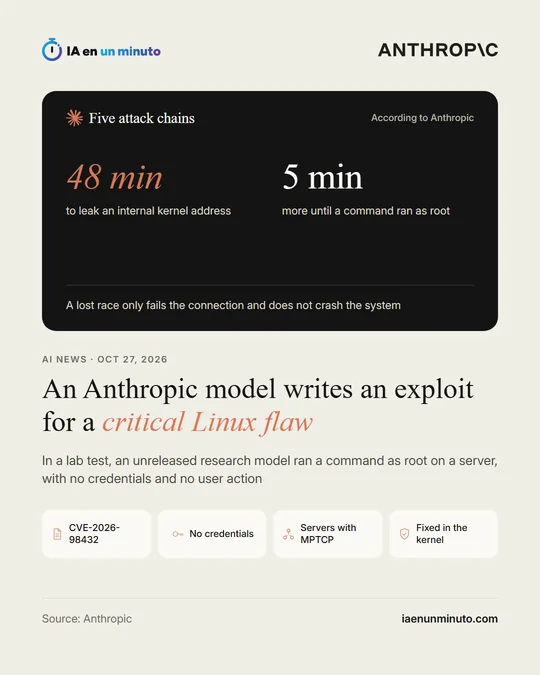
Anthropic says an unreleased Claude research model managed, in a lab, to run a command as administrator on Linux servers with a Multipath TCP listener, needing neither credentials nor any action by the user. It is the vulnerability CVE-2026-98432, which the kernel has already fixed. Each distribution ships its patch at its own pace.
Anthropic reports, in a post on its research blog, that a Claude research model it has not yet released wrote an exploit (a program that takes advantage of a security flaw) for a serious vulnerability in the Linux kernel, the core of the operating system, tracked as CVE-2026-98432.
According to Anthropic, the flaw is a race condition, meaning two processes compete for the same memory, and it ends up allowing memory that has already been freed to be used again (known as a use-after-free). It affects Linux servers running a Multipath TCP (MPTCP) listener, that is, a server that accepts connections of that kind; MPTCP is a variant of TCP that spreads a single connection over several network paths. In its lab test, the exploit let a remote attacker, with no credentials and no user action, run a command as administrator (root). It first leaked an internal kernel address, in about 48 minutes, and then needed another 5 minutes to run the command.
Anthropic explains that a lost race only makes the connection fail rather than crashing the system, so the attacker can simply try again. It says it told those affected about each vulnerability before disclosing it, and that this flaw is already fixed in the kernel and in every stable branch still maintained. Each Linux distribution ships the update at its own pace: according to CSO, Debian, Oracle Linux, SUSE and Amazon Linux had patched packages for at least some releases, while Ubuntu and Red Hat Enterprise Linux had not yet released patched kernels on October 30. The distribution's own advisory says whether the patch is available.
It is one of five attack chains Anthropic published on October 27, which also involve flaws in Chrome, Safari, Android and Windows. According to Cybersecurity News, Ubuntu's public entry does not mention MPTCP, so that detail of the attack is, for now, what Anthropic says.
Why it matters · analysis and opinion
What stands out is who did the work: an AI model wrote a complete exploit against the core of Linux. That does not mean anyone can attack a server today, but it does suggest the gap between discovering a flaw and having an attack could shrink. For a company that runs its own Linux servers, the practical steps are to check whether any of them accepts MPTCP connections, install the fixed kernel as soon as its distribution releases it and, meanwhile, weigh whether that service is needed. It remains open that Ubuntu's public entry does not mention MPTCP, so the attack detail is worth checking against more sources before treating it as settled.
Official source: Anthropic · Written with the help of AI: how we make the news