New York passes a law limiting what AI chatbots can do with minors
IA en un minuto newsroom · Editor: Jon Elgezabal
In 30 seconds
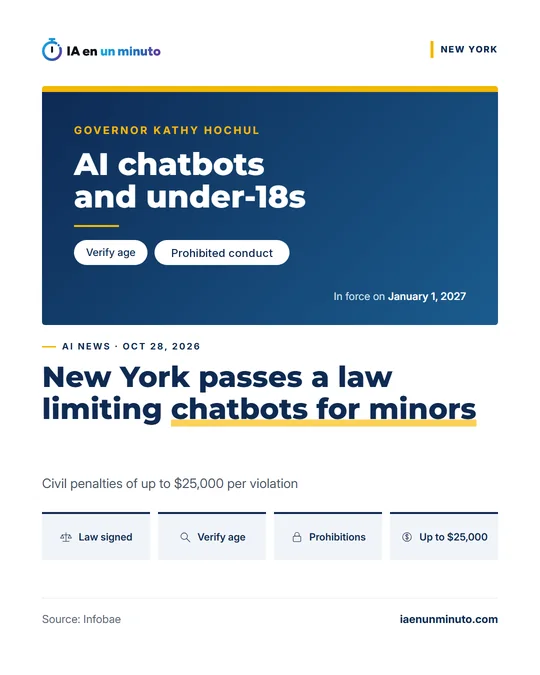
New York has passed a law that limits what AI chatbots can do in conversations with people under 18. Companies will have to verify age using at least two methods, and chatbots may not fake emotions, offer sexual content or push a minor to hide secrets. The state Attorney General can seek civil fines that may reach $25,000 for each violation, and the rules are expected to apply from January 1, 2027.
New York Governor Kathy Hochul signed a law on Wednesday, October 28, that regulates what AI chatbots may do in their conversations with people under 18. Infobae describes it as the first state rule in the US dedicated specifically to the issue, and DW reports that the governor herself calls it a pioneering measure nationwide.
The law requires the companies that own chatbots to check users' ages using at least two different methods, and one of them cannot rely solely on an official ID. Once they confirm that the user is a minor, they must block the features the law considers harmful.
The conduct barred with minors includes simulating emotions or real relationships, pretending to be a real person or alive, offering sexually explicit content, promoting or facilitating suicide, self-harm, eating disorders or drug and alcohol use, and encouraging the minor to keep secrets or avoid seeking help from trusted adults or professionals. According to the governor's office statement cited by DW, chatbots also cannot put unsolicited emotional questions to the minor or use personal or health information from earlier conversations.
If a company breaks the rules, the state Attorney General may seek civil penalties of up to $25,000 per violation, as well as damages and restitution, and demand the destruction of improperly obtained data and of the AI models trained on it. According to Infobae, the law is due to take effect on January 1, 2027.
Infobae places the measure in a context where states are legislating on their own because of the lack of progress in the federal Congress. It also reports that a nonprofit focused on data protection and AI governance warned that several categories in the law are drafted too broadly or without precise definitions, which could complicate enforcement in practice.
Why it matters · analysis and opinion
The law arrives while the federal Congress is stalled, so AI companies face a patchwork of rules that each state writes on its own. Anyone offering an assistant that can talk with minors, even if they are not its main audience, should check whether the service simulates emotions, asks for confidences or encourages hiding things from parents. The criticism reported by Infobae points out that several categories are drafted very broadly, so the real reach will only be clear once the law is applied. Anyone building third-party chatbots into a website or app can already ask their provider how it checks age and what it does when it detects a minor, and keep the answer in writing.
Source: Infobae · Written with the help of AI: how we make the news