NVIDIA releases Nemotron 3.5 Transcribe, an open transcription model for up to 40 languages
IA en un minuto newsroom · Editor: Jon Elgezabal
In 30 seconds
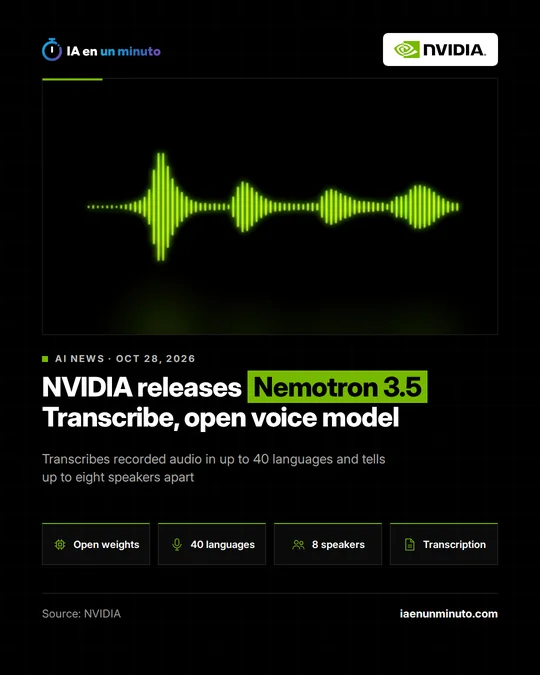
NVIDIA has released an open, free model that transcribes speech recordings in as many as 40 languages. NVIDIA says it also translates 31 languages into English and out of it, copes with an hour of audio and separates up to eight different voices. It is not meant for live broadcasts and is aimed at people building apps for meetings and medical transcription.
NVIDIA has released Nemotron 3.5 Transcribe, a free open-weight model (one anyone can download and use) that turns recorded speech into text in up to 40 languages. In its Hugging Face post, the company says a single checkpoint covers transcription, speaker attribution, translation and questions about the audio. Of those 40 languages, 31 can be translated into or out of English and speakers can be labeled in 13, and a recording can run for an hour with as many as eight speakers told apart.
NVIDIA says it tops the English transcription ranking for open-weight models, with an average word error rate of 5.33%. TechCrunch adds that the company claims the model beats rivals on several benchmarks.
Granary v2, the company's open-source speech dataset, comes out alongside it. Its public manifest lists 463,062 hours of audio across 48 languages, against 25 languages in the previous version.
Transcribe is meant for pre-recorded audio rather than live streams. TechCrunch says it targets developers of business-meeting and medical-transcription apps. NVIDIA says developers can tune it to industry jargon with Granary v2 and its NeMo Speech tools, and that its 30 billion parameters can still fit on one chip, from the Jetson AGX Thor and DGX Spark to Blackwell data-center processors. The company advises spot-checking names, speaker changes and answers, as with any speech model.
Why it matters · analysis and opinion
An open-weight model lets transcription run on a company's own machines, which matters when the audio holds sensitive data, such as a medical consultation or a board meeting. The trade-off is that it needs suitable hardware and someone to maintain it, and NVIDIA itself recommends checking names, speaker changes and answers, because no speech system is infallible. Nor does it work, for now, for live captioning. Anyone already paying for a transcription service can try it on their own recordings and compare the result with their current provider's, especially if they work with technical jargon from their sector.
Official source: NVIDIA · Written with the help of AI: how we make the news