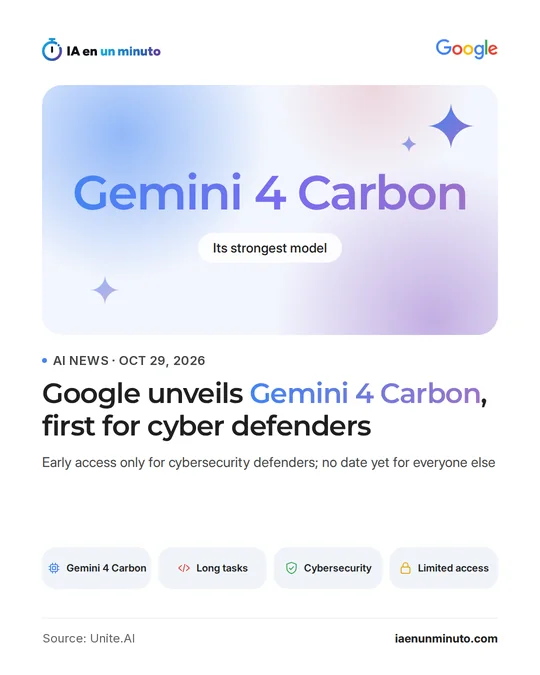
Google unveils Gemini 4 Carbon, its strongest model, and opens it first only to cybersecurity defenders
IA en un minuto newsroom · Editor: Jon Elgezabal
In 30 seconds
Gemini 4 Carbon, which Google calls its strongest model, reaches only a group of cybersecurity defenders for now. With 59 points it leads the Artificial Analysis ranking, and Google boasts solid results at finding and fixing vulnerabilities. Developers, businesses and consumers will wait with no date while the company keeps tuning its safeguards.
Google unveiled Gemini 4 Carbon on October 28, a model it describes as the strongest in its lineup, but for now only a small group of cybersecurity defenders receive it. According to Unite.AI, the company will widen access in stages to more trusted partners through Google DeepMind's Fairwind Program, an early-access scheme meant for governments, critical infrastructure operators and technology platforms. There is no date for developers, businesses or consumers: Google says it will keep gathering feedback and tuning the safeguards, and wants to offer it as soon as it can. It also says it is taking part in the US government's voluntary process for testing models before release.
Carbon succeeds Gemini 4 Argon and, according to Google, is built for long engineering problems and workflows with agents: its internal teams have watched it run for days on complex tasks, such as finding and fixing subtle bugs in large codebases. With 59 points it tops version 5.0 of the Artificial Analysis Intelligence Index, an independent ranking of models. According to R&D World, which draws on Artificial Analysis data, Anthropic's Opus 5.5 scores 58 points, GPT-6 Astra 57 and Argon itself 50 on that same version of the index.
In cybersecurity, Google reports 88.2% on SEC-bench Pro (discovering vulnerabilities), 54.8% on ExploitGym (checking whether they can be exploited) and 71.0% on CWE-bench (fixing them at the root). R&D World points out that those external tests were run with safeguards switched off, which limits how far they carry over to the product with them on.
The launch price is the same as Argon's: 2 dollars per million input tokens and 10 per million output tokens, rising to 4 and 20 when the promotion ends, with a 95% discount on input held in cache. According to Artificial Analysis, cited by R&D World, Carbon produced 200 million output tokens in its tests, roughly three times the median of comparable models, at a weighted average cost of 7.76 dollars per task: less than Opus 5.5 at maximum reasoning (10.04) and more than GPT-6 Astra (6.24). It also took a median of 97.5 seconds to deliver its first token through Google's API, against 3.6 seconds for comparable models.
Why it matters · analysis and opinion
That Google offers its most capable model first to those who protect systems, and not to the general public, points to a rationing criterion worth watching: the more powerful the model, the more conditional the access. A company that works with Google AI should plan without assuming when Carbon will reach its plan and, meanwhile, carry on with what it already has under contract. The security figures come from Google itself and were measured without safeguards, so they serve as a guide until independent tests exist on the real product. There is another practical detail: heavy token use can make each task costlier even if the price per token does not change, so it is worth measuring the real cost on a case of your own before migrating.
Source: Unite.AI · Written with the help of AI: how we make the news