IA en un minutoNewsBusiness and products
Anthropic publishes first results of its Claude AI in drug development with six partners
IA en un minuto newsroom · Editor: Jon Elgezabal
In 30 seconds
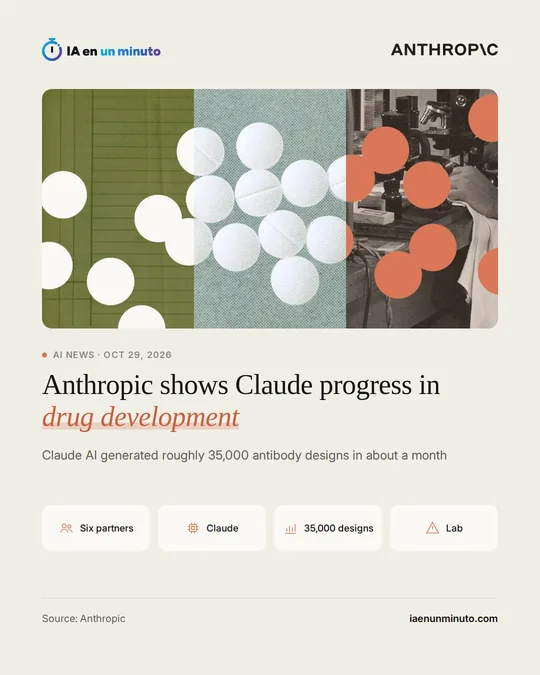
Anthropic's life sciences team has put Claude to work on real programs with six partners, among them Bristol Myers Squibb, Generate Biomedicines and Divergence Labs. In the lab, one design for a cancer therapy cut its length by roughly 70% and performed better, and for food allergies Claude generated roughly 35,000 antibody designs. Anthropic stresses that everything is preclinical, with no tests in people yet.
Anthropic has published the first results of Claude, its AI model, in drug development. Its life sciences team has spent several months working with six organizations: BigHat Biosciences, Bristol Myers Squibb, Divergence Labs, Enveda, Generate Biomedicines and The Column Group. According to its report, the company has also started programs of its own, among them one on rare childhood forms of muscular dystrophy in which Claude takes on much of the scientific and operational work.
The two most striking cases are Generate and Divergence. Generate Biomedicines is trying to adapt CAR-T therapy, so far used against blood cancers, to solid tumors, and to do so it wants to shorten one stretch of the therapy's genetic instructions. Six of its scientists asked Claude Code, Anthropic's coding tool, for new designs. One came out roughly 70% shorter than the usual one and, in lab tests, worked better: the immune cells produced roughly ten times as many receptors, destroyed tumor cells more efficiently and stayed active for longer.
Divergence Labs is pursuing a different route against food allergies: drugs that pull the IgE molecule off immune cells, instead of neutralizing only the IgE circulating in the blood. Claude turned its goals into a design plan and, largely on its own, produced roughly 35,000 antibody designs in about a month. Early tests turned up three that bind to IgE and twenty able to dislodge it; three of those twenty seemed to do so better than the standard medicine. The next step is to build a drug that combines both functions.
The report adds further examples. BigHat Biosciences, which pairs AI with an automated lab, tested roughly 1,010 variants of two molecules in around ten weeks, and the best ones bound to their target more than ten times as tightly. At Enveda, where manufacturing chemists spent up to 75% of their time on paperwork, Claude reviewed 1,061 pages of documentation, caught all 11 problems human reviewers had spotted and flagged seven more they had missed, and review time dropped by 89%. Bristol Myers Squibb uses it to assess the plans of a clinical trial and estimate its chances of success, and The Column Group is setting up a new company, Pleiades, that will lean on Claude to run more programs than usual with a small team.
Anthropic acknowledges that all this is at an early stage and that the results are mostly preclinical: the drugs have not yet been tested in people. Its strategy is for AI to take part in the whole process, not just in proposing molecules, and it says it wants to scale this work up substantially, bringing in more partners and taking Claude into clinical trials as the programs advance.
Why it matters · analysis and opinion
The most useful part of this report is the method: instead of stopping at proposing molecules, Anthropic spreads Claude's work across the whole drug chain, from manufacturing paperwork to trial planning. It shows where the most tangible saving is today: review and documentation tasks that eat hours of highly qualified staff. What is missing is the decisive part. The results are mostly preclinical, are told by Anthropic itself with technical reports for each case, and no drug has yet reached tests in people. Any healthcare organization considering something similar would do well to start with a narrow, measurable process, compare it with human work and demand that every claim can be checked.
Official source: Anthropic · Written with the help of AI: how we make the news