IA en un minutoNewsBusiness and products
SAP plans to bring its AI model for table data to the International Space Station
IA en un minuto newsroom · Editor: Jon Elgezabal
In 30 seconds
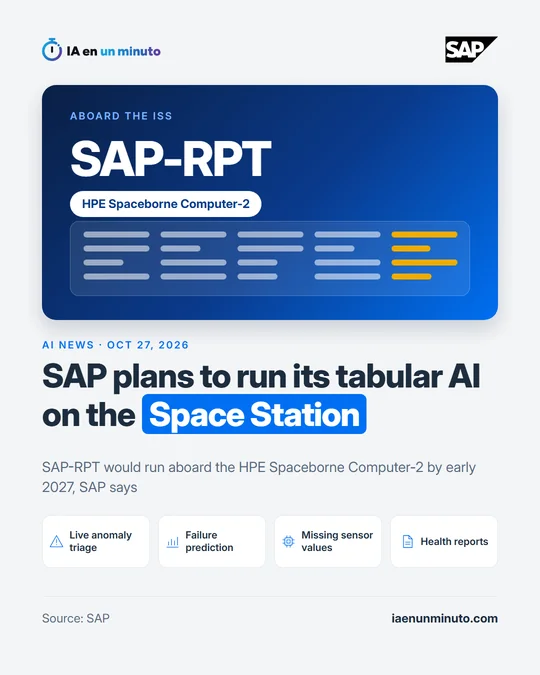
SAP wants SAP-RPT, its tabular AI system, to analyse telemetry inside the International Space Station instead of sending everything down to Earth. According to SAP, it would do so with the HPE Spaceborne Computer-2 by early 2027. SAP says it would flag anomalies and failures and explain the state of the mission, with an energy use roughly 50,000 times lower than that of the most powerful language models.
SAP has announced that it plans to install SAP-RPT, its artificial intelligence model for structured table data, on the HPE Spaceborne Computer-2, the HPE computing system that operates aboard the International Space Station (ISS). According to the company, the deployment will arrive by early 2027. It says so in an article on its news site signed by Brenda Bown, chief marketing officer for SAP Business AI Platform and Joule.
The reason SAP gives is that the sensors and telemetry of the mission systems produce more time-sensitive data than can be sent to Earth for analysis, and that latency has to be reduced to keep the spacecraft safe. That is why the model would work on the station itself and not from the ground.
According to SAP, SAP-RPT makes predictions directly from structured data, even when some of it is missing, and without the usual training or fine-tuning. On board it would be used to triage anomalies in telemetry in real time, anticipate problems before they get worse, reconstruct missing sensor values from historical data and produce mission health reports that can be explained to astronauts and ground teams. The company adds that it would also provide an overall mission risk score and an assessment of whether manual intervention is needed.
SAP states that SAP-RPT uses roughly 50,000 times less energy than state-of-the-art large language models, something that weighs heavily in space because every watt counts, and that it needs no pre-training when conditions change. The model belongs to its family of foundation models for tabular data, alongside TabPFN from Prior Labs, and is managed with SAP AI Core. The company presents the project as a step towards its road map for enterprise edge AI, with uses in disaster relief operations, agriculture in remote areas, distributed manufacturing and widely spread supply chains.
It is not deployed yet: this is a plan announced on October 27, 2026.
Why it matters · analysis and opinion
The most interesting part is not the rocket but the underlying message: SAP wants to show that models built for tables, and not only language models, can work with few resources and without a permanent connection. It is a way of placing its product in the day-to-day operations of companies, where almost everything is spreadsheets, records and sensors. SAP already talks about uses with suppliers, cash flow and machinery breakdowns, but those uses are a promise from the company, not a measured result. For now the essential is missing: the deployment has to be completed and someone outside SAP has to check whether the model gets it right. For a small business with table data, the practical question is whether it can already try it on its own; SAP invites people to do so on its website.
Official source: SAP · Written with the help of AI: how we make the news