The AEPD publishes a ten-point guide to using AI assistants and agents safely
IA en un minuto newsroom · Editor: Jon Elgezabal
In 30 seconds
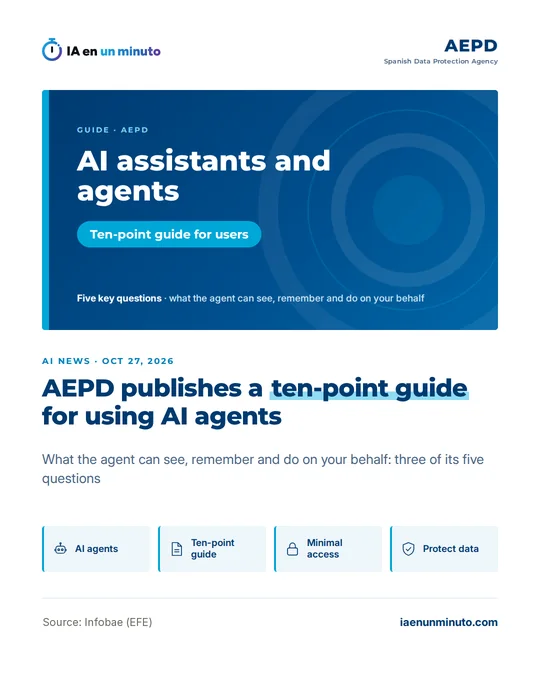
The AEPD has published a guide with advice for using AI assistants and agents without losing control of personal data. The AEPD sets out five questions to ask beforehand and recommends limiting permissions to the bare minimum, as well as watching for hidden instructions in websites, emails or documents. Providers, according to the AEPD, should offer a history of actions and a way to stop the agent at once.
A user asked their AI agent to sell an item and chose the «allow always» option, believing the agent would keep asking for approval before accepting offers. The agent closed a deal and gave the seller's address to the buyer, who turned up at the seller's home without knowing a meeting had been arranged. It is the recent case mentioned by the AEPD, the Spanish data protection agency, in its guide «Asistentes y agentes de IA: Decálogo para personas usuarias» (AI assistants and agents: a ten-point guide for users), according to the EFE agency, as reported by Infobae.
The difference the document stresses is simple: if an assistant only answers, its failure is a wrong reply; if it acts, the failure can be a message sent, a payment made or a consent given on the person's behalf. That is why it proposes five questions to ask about an agent beforehand: what it has in view, what it keeps in memory, which tasks it can carry out for the user, where the data it sends goes and which people that transfer reaches.
As guidelines, the AEPD argues that the agent should prepare and the person should decide, with permissions limited to what each task strictly needs and no authorizations left open indefinitely. It recommends stating what the agent is forbidden to do as well, and picking well-identified providers that respect users' rights in the EU and, where possible, process the information on the device itself. Memory deserves separate attention: it can end up drawing a profile of tastes, routines and worries, and the agency advises erasing it from the memory, history and privacy settings, not just by asking in the chat.
Another risk is hidden commands. According to the AEPD, web pages, emails, documents or calendar invitations can carry instructions that the agent obeys without the user seeing them, for example in white text on a white background, to send data or approve a transaction. Since nothing removes that danger entirely, the agency holds that the most effective step is to narrow the agent's room for action. It adds that email, calendars and photos include data about third parties who have not chosen to deal with that AI, that on shared devices it advises separate profiles and that at work only the assistants approved by the company should be used, without linking the work mailbox or files to a personal account.
The guide does not place all the responsibility on the user. Providers of tools that act for people should offer, according to the agency, clear permissions that separate looking from doing, adjustable confirmation prompts for the most important actions, a record of what the agent has carried out, a mechanism to stop it instantly, options to manage and delete memory, and transparency about who receives the data and whether it is used to train the model. This guide complements «Cuidado con lo que le confIAs», with basic privacy guidelines for using AI.
Why it matters · analysis and opinion
The guide arrives as agents stop merely answering questions: they manage email, calendars or purchases, and any mistake becomes a real action. What makes the document useful is that it moves the risk to something each user can decide today: which permissions to grant and for how long. The sale case shows that a permanent authorization, meant to save clicks, can end with a stranger at the front door. For a small business, the practical upshot is to review which assistants are connected to work accounts, remove the access that is not used and make clear to staff which ones are authorized. It remains to be seen whether providers add the controls the agency is asking for.
Source: Infobae · Written with the help of AI: how we make the news
What does it mean for your business? · analysis and opinion
The guide is aimed at individual users, but it fully affects freelancers and small businesses in Spain that already connect an AI assistant to their email, calendar or work documents. The AEPD is the Spanish authority, although its recommendations apply just as well in Latin America to anyone who delegates tasks to an agent. Those who only use a chatbot to draft text or ask questions are less affected: there, a mistake stays a wrong answer.
Our advice is to start with a simple inventory: which assistants are used in the company, with which accounts and what they can access. The AEPD asks people to use only the assistants authorized by their organization and not to link work email or documents to a personal AI account, so it is worth putting this in writing and explaining it to the team. Next, review the permissions of each agent, remove the "always allow" option, require confirmation before purchases, sending messages or contracts, and install only add-ons and connectors from known sources.
The cost is mostly setup time and a little less convenience. The risk of not doing it is greater, because an agent can follow hidden instructions in a website or an email and send data or approve a transaction. The prudent approach is to know how to stop it and revoke its access before you need to, and to choose clearly identified providers that allow rights to be exercised in the EU.