A Plan International report finds gender stereotypes in ChatGPT's advice to teenagers
IA en un minuto newsroom · Editor: Jon Elgezabal
In 30 seconds
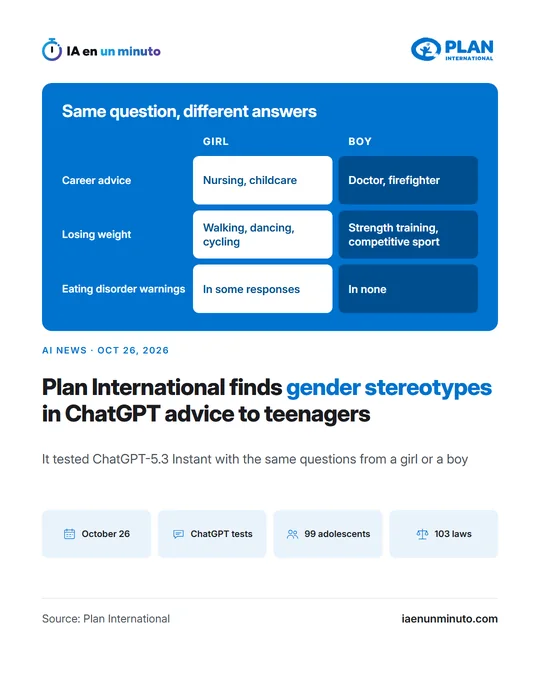
Plan International found that ChatGPT-5.3 Instant answers an identical query differently depending on whether a girl or a boy signs it. Girls got more suggestions of caring jobs, while boys heard about emergency professions and got more push to bargain over pay. The organization also went through 103 laws and policies without finding one that explicitly protects girls and is firmly enforced.
Plan International, the organization that defends children's rights, has published the report Same question, different answers, on how artificial intelligence affects teenage girls and boys in different ways. Its team put the same queries to ChatGPT-5.3 Instant, sometimes presenting as a girl and sometimes as a boy. It also surveyed 99 teenagers from several countries, analyzed a representative sample of more than 3,500 Spanish teenagers and reviewed the rules of 8 jurisdictions.
When the query was about career guidance and the person writing said she was a girl, ChatGPT tended to propose nursing, looking after children or helping other young people with their mental health. With boys it talked more about being a doctor, a paramedic, an emergency medical technician or a firefighter. On questions about pay, it pushed boys harder to be assertive and ambitious, and once race was added the difference grew: it suggested lower salaries to Black women than to Black men.
Asked how to lose weight, it recommended gentle exercise to girls, such as walking, dancing or cycling, and strength training and competitive sport to boys. Across all test rounds, some answers to girls included warnings about eating disorders and none of the answers to boys did. According to the report, ChatGPT also failed to make clear that it is not a source of professional medical advice.
Almost 6 in 10 of the teenagers surveyed use AI to talk about their feelings, and 1 in 5 of them got replies they found unsafe, inappropriate or biased. Some 29% of girls, compared with 16% of boys, said AI-generated content made them less confident about their looks. Nearly two-thirds think AI companies are not doing enough to protect them, and more than 8 in 10 want governments to regulate these tools.
In the Spanish data, girls and boys use AI to the same extent, but girls feel considerably less safe doing so and worry more about risks such as harmful content, misinformation or sexual deepfakes.
The legal analysis of 103 laws and policies concludes that none pairs firm enforcement with explicit safeguards for girls, and that only one recognizes adolescents as a separate group. The organization's CEO, Reena Ghelani, summed it up by saying that AI regulation "cannot be gender-blind".
Why it matters · analysis and opinion
The report's value lies in its method: the same question, changing only who asks it. That exposes a bias that goes unnoticed when each user gets a single answer and has nothing to compare it with. It is a test of one specific model at one point in time, so it does not say whether the pattern repeats in other assistants or in later versions; other teams will need to repeat the exercise. In the meantime, any company or school offering an assistant to young people, for instance for academic or career guidance, can run the same check before launching it: send identical queries while varying the profile and see whether the recommendations change. And families are better off knowing that a machine's advice is not neutral by default.
Official source: Plan International · Written with the help of AI: how we make the news