The UK announces an AI biosecurity lab with £100 million and backing from OpenAI, Anthropic and Google DeepMind
IA en un minuto newsroom · Editor: Jon Elgezabal
In 30 seconds
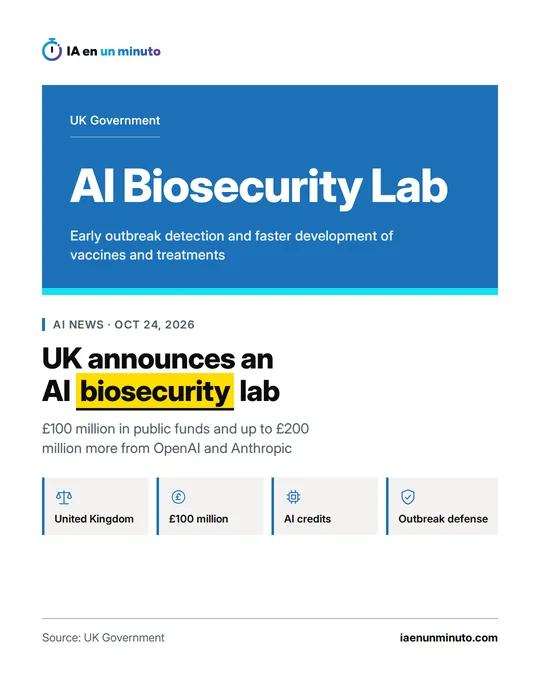
The British government is setting up the AI Biosecurity Lab, a non-profit body that will apply AI to watching for biological risks and preparing medical responses. OpenAI and Anthropic are adding up to £200 million in credits, compute and support on top of £100 million in public funds. Google DeepMind and Basecamp Research will take part as research partners.
On Saturday, October 24, the British government announced the AI Biosecurity Lab (AIBL), a lab that will use AI to spot biological threats sooner and react faster to disease outbreaks. According to the Cabinet Office, it will be the first organization anywhere devoted solely to AI-driven biosecurity.
It will have £100 million in public money and up to £200 million more pledged by OpenAI and Anthropic. OpenAI will put in £100 million in computing capacity and credits for its models, and will give trusted access to the most capable ones through its Rosalind Biodefense program. Anthropic will contribute up to £100 million in credits, access to its models and its own technical support. Google DeepMind and the British company Basecamp Research will collaborate on research: the former with its scientists and biosecurity experts, and with the aim of opening access to Gemini and to specialized science models; the latter with its AI models for biology.
It will run as an independent non-profit organization, with a scientific advisory committee whose details the government will give later. At first it will concentrate on two fronts: finding emerging biological threats as early as possible and shortening the path to vaccines, treatments and other medical countermeasures. It is born within a National AI Biosecurity Initiative that also includes the health security agency (UKHSA), the animal and plant health agency (APHA) and the defence science and technology laboratory (Dstl), and it will work with the medicines regulator (MHRA) to prepare for health emergencies and to guide the regulation of drugs designed with AI. Over time, the government wants it to receive philanthropic money as well.
The lab is one piece of the AI investment package previewed by the UK Treasury, which the Chancellor will include in his Budget. That package sets aside £165 million for the new biosecurity initiative: the lab's £100 million and another £65 million to strengthen biological surveillance and develop medical countermeasures against priority pathogens. It also includes a further £120 million for the AI Security Institute, the public body that tests new AI systems.
AI Minister Kanishka Narayan described it as "a major new global institution" that will gather top scientific experts to keep people safe from new biological threats. The official announcements do not say where it will be based or when it will start work.
Why it matters · analysis and opinion
That OpenAI and Anthropic are contributing credits and access to their models, and not just money, says a good deal about how the relationship between governments and AI companies is changing: the state provides the structure and the companies, the computing power. The lab draws on the AI Security Institute and takes that formula into sensitive territory, where the same technology that speeds up a vaccine can make harmful uses cheaper. Almost everything practical is still unknown: the location, the start date, who will run it and under what rules other centers will get access to the models. For British research groups and life sciences companies, the useful thing now is to follow how its scientific committee takes shape and what collaborations it offers, because that will be the way to work with the most advanced models in this field.
Official source: UK Government · Written with the help of AI: how we make the news