OpenAI's cybersecurity program has found 1,995 flaws in open-source software and 1,316 are still waiting for a patch, according to Forbes
IA en un minuto newsroom · Editor: Jon Elgezabal
In 30 seconds
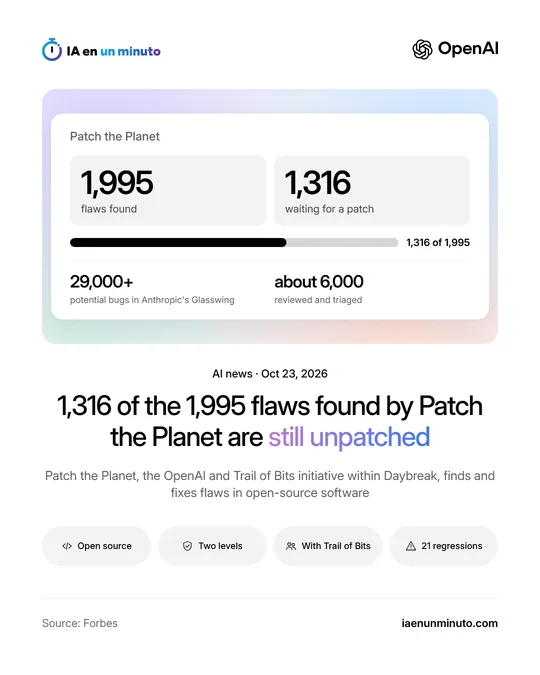
Patch the Planet has turned up 1,995 security flaws in open-source code, and 1,316 still await a fix. Anthropic cannot keep up with Glasswing either: it has logged more than 29,000 possible bugs and reviewed only about 6,000. Trail of Bits, for its part, found 21 regressions in the more than 130 patches by its engineers already merged by the projects.
Patch the Planet, the initiative run by OpenAI and the security firm Trail of Bits to find and fix vulnerabilities in open-source software, has found 1,995 security flaws, and 1,316 of them still have no patch. The figures come from the initiative's own data and were published on Friday, October 23, by Thomas Brewster in a Forbes report on OpenAI's cybersecurity lab, which Forbes Spain has also published in translation.
OpenAI launched Patch the Planet on June 22 as part of Daybreak, its cybersecurity program. Trail of Bits assigned full-time engineers to work with Codex and GPT-5.5-Cyber on 19 open-source projects, and participating projects receive ChatGPT Pro, API credits and, under conditions, Codex Security. According to Forbes, those using Daybreak and Patch the Planet have so far made nearly 2,000 flaws public, and OpenAI and its partners keep confirming new ones every day.
OpenAI only lets selected organizations into Daybreak and has declined to say how many there are. The program has two levels. Daybreak Blue, designed for an ordinary security team, opens up OpenAI's latest general model without the limits it usually has for cybersecurity tasks. Daybreak Red, for more thorough penetration testing, gives access to OpenAI's security-focused GPT models, and the company vets each applicant closely. Joining costs nothing; what organizations pay for is their use of the models.
Block, Jack Dorsey's company that runs Cash App, is among the first Daybreak Red customers. Its chief information security officer, James Nettesheim, tells Forbes that the AI does in a few hours work that used to take Block's offensive security team days or weeks, though Nettesheim warns that attackers will also be able to do many of those things.
According to Forbes, the volume of bugs waiting to be fixed is overwhelming even the large AI labs. Anthropic, which has its own equivalent program, Glasswing, says it has detected more than 29,000 potential bugs, of which it has only managed to review and triage about 6,000; in a post earlier this month it acknowledged that what holds it back is the human capacity to validate the findings.
Fixing with AI help does not come out perfect either. On Wednesday, October 21, Trail of Bits published its review of every patch by its engineers that the projects had already merged, more than 130 in all. It confirmed 21 regressions, meaning changes that broke something that used to work: 16 functional, one performance and four in builds or tests. None of them broke a security protection. An agent looked for possible problems and engineers checked them: the 21 confirmed came out of 58 candidates. Drawing on what it learned, the firm has released two plugins, patching-bugs and regression-hunt, so agents can prepare patches and look for regressions. Forbes adds that, according to the firm, checking what the AI does took a lot of human review time.
The flaws uncovered by Patch the Planet include the two critical PHP vulnerabilities that OpenAI made public on October 21, once the fixes had been checked; according to Forbes, they were found by GPT-5.6 Sol, OpenAI's flagship model. Amazon data cited by Forbes show that someone had already used them in attacks before they were disclosed, and Amazon's chief information security officer, C.J. Moses, wrote that it is unclear how the attacker got the details of the vulnerability. According to Forbes, 38 million systems still run vulnerable versions of PHP.
Why it matters · analysis and opinion
What matters is not how many flaws turn up, but how many are left unfixed: AI has made hunting for vulnerabilities so cheap that the bottleneck has moved to the people who maintain the code, who in projects like PHP are a handful of volunteers. That narrows the window between a flaw becoming known and someone exploiting it, and that same case has shown it. Anyone running their website or servers on open-source software would do well to treat security updates as urgent, know which versions they have running and not accept a patch just because an AI wrote it: the people behind the initiative admit that, without human review, it is still not enough.
Source: Forbes España · Written with the help of AI: how we make the news