OpenAI signs an agreement with Polish institute NASK to research AI safety
IA en un minuto newsroom · Editor: Jon Elgezabal
In 30 seconds
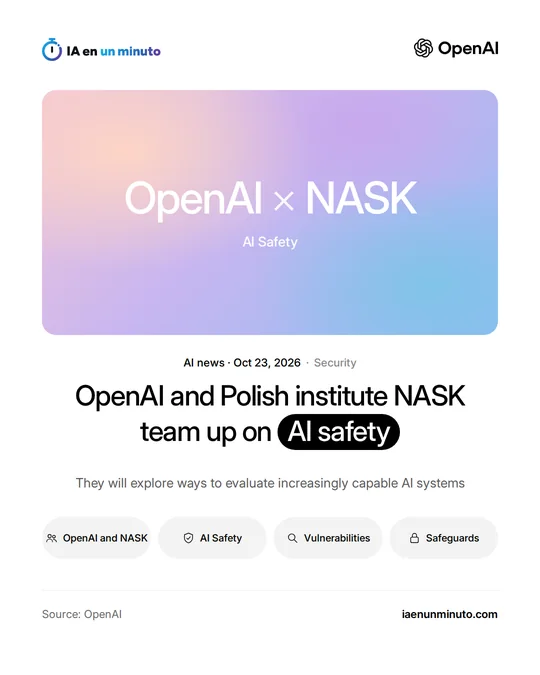
OpenAI will team up with NASK's AI safety center to find ways of measuring ever more powerful models and protecting them better. CERT Polska, part of NASK, already used OpenAI models in July to uncover six flaws in MikroTik routers, which the vendor has fixed. OpenAI thus adds a Polish partner to the public bodies it already works with in the US and the UK.
OpenAI and NASK, Poland's National Research Institute, have signed an agreement to look at working together on AI safety and security and on technical research. OpenAI announced it on Friday, October 23.
The work will run through NASK's AI Safety Research Center, which acts as Poland's institute for artificial intelligence safety. The two sides will look for methods to assess AI systems as they grow more capable, spot possible weaknesses and shore up protections. According to NASK director Radosław Nielek, the center researches protections against new risks, the detection of synthetic content generated with AI, malicious uses of the technology and what changes when a problem spans several languages.
The deal has a precedent. In July, CERT Polska, the incident response team that runs inside NASK, was given access to OpenAI models built for cybersecurity tasks through Daybreak, the company's cybersecurity program. With their help it uncovered six vulnerabilities in RouterOS, the system that runs MikroTik routers; some of them, chained together, let an attacker take over affected devices without authenticating. The vendor published fixes, and CERT Polska confirmed they stopped the attacks it had seen.
OpenAI already works with public bodies such as CAISSI in the United States and the UK's AI Security Institute, and has urged the US to agree international technical standards for the most advanced AI with other countries. Tom Duff Gordon, OpenAI's vice president and head of policy for Europe, the Middle East and Africa, says it is essential to draw on expertise from outside the company to question its assumptions and put its systems to the test. Nielek argues that AI safety cannot be reached by one party alone and needs cooperation between public institutes and the developers of the most advanced models.
Why it matters · analysis and opinion
The most telling part of the announcement is not the signing but what came before it: a public incident response team used AI models to find serious flaws in network equipment, and the vendor had to fix them. AI is no longer only evaluated from the outside: it is also being put to work on defense, and public institutes want to be inside to see first-hand what these models can do. Anyone with routers or firewalls in their office would do well to know which model they use and to install the vendor's updates as soon as they come out, because flaws are being found faster and faster. What the agreement with NASK leaves out is the key part: which specific evaluations they will run, with what access to the models and whether they will publish the results.
Official source: OpenAI · Written with the help of AI: how we make the news