IA en un minutoNewsBusiness and products
Pathos AI raises $237 million and partners with Bristol Myers Squibb and Tempus AI to develop Alzheimer's drugs with AI
IA en un minuto newsroom · Editor: Jon Elgezabal
In 30 seconds
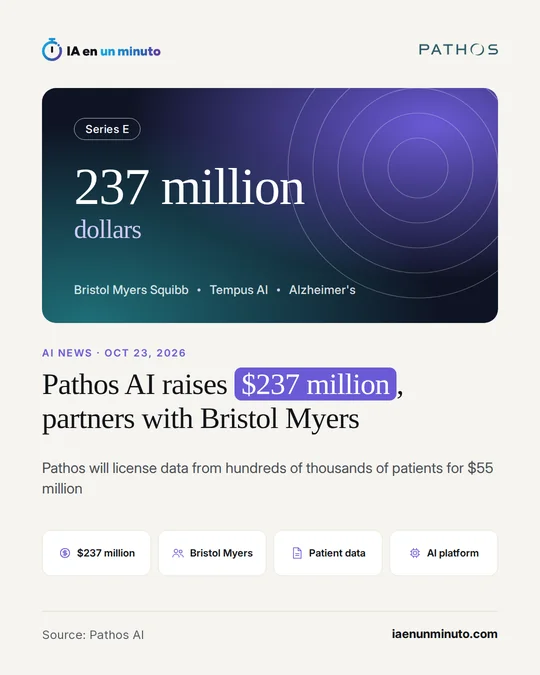
Bristol Myers Squibb heads a $237 million investment in Pathos AI, which is now worth about $3 billion. Tempus will gather information on hundreds of thousands of neurological patients, and Pathos will use it for five years, for $55 million, to look for new Alzheimer's treatments with its Pathos Foundry platform. For three years, Bristol Myers can apply the platform exclusively to its neuroscience projects.
Pathos AI has closed a $237 million Series E funding round, led by Bristol Myers Squibb and joined by investors who already held a stake in the company. The deal, announced on Friday, October 23, puts the value of the New York-based company at about $3 billion after the raise.
On the same day, Pathos announced two multi-year collaborations, with Bristol Myers Squibb and with Tempus AI, to build AI tools for developing drugs against Alzheimer's and other neurological diseases. Tempus will assemble an anonymized, longitudinal dataset (one that follows each patient's progress over time) covering hundreds of thousands of people with neurological disorders, and Pathos will license it for five years under a $55 million agreement. Pathos will analyze it with Pathos Foundry, its AI platform, to build and check hypotheses about the biology of these diseases and to guide the design of clinical trials that are more targeted and adaptive.
For three years, Bristol Myers will hold exclusive rights to apply the platform to its neuroscience programs, plus non-exclusive access to Foundry across the rest of its research portfolio. According to Pathos, Foundry runs on thousands of specialized AI agents that pull together the clinical, genomic and competitive data of each program in real time to suggest the next decision; so far the company has used it in oncology, where it has four drugs in clinical development. Its chief executive, Iker Huerga, argues that neurological diseases require more than a single company can provide: the best long-term patient data, AI able to reason over it at scale, and the expertise to turn findings into medicines.
The money from the round will go to expanding Foundry and speeding up that development, starting with JSKN016, a bispecific antibody-drug conjugate aimed at TROP2 and HER3 that Pathos wants to take into registration studies. It will also fund pocenbrodib, for prostate cancer and multiple myeloma; AZD4241, developed with AstraZeneca; and DO-2, a MET kinase inhibitor. The companies have not said when the Tempus dataset will be ready or when the first neurology trials will begin.
Why it matters · analysis and opinion
That a major drugmaker is leading the round says more than the amount: companies in the sector no longer just buy an AI tool, they take a stake in whoever builds it and reserve its use in their own field. Pathos's promise is to pick better which patients may benefit from a treatment and to adjust trials as they go. But the method has been tested in cancer, not in brain diseases, and the dataset is still to be built. The real test will not be the company's valuation but whether the trials that come out of this partnership succeed more often than earlier ones. For hospitals and laboratories the message is also clear: well-organized, anonymized clinical records have become an asset that someone will pay for.
Official source: Pathos AI · Written with the help of AI: how we make the news