Microsoft open-sources Agensh, which gets up to 1,024 AI agents working as a team without a central coordinator
IA en un minuto newsroom · Editor: Jon Elgezabal
In 30 seconds
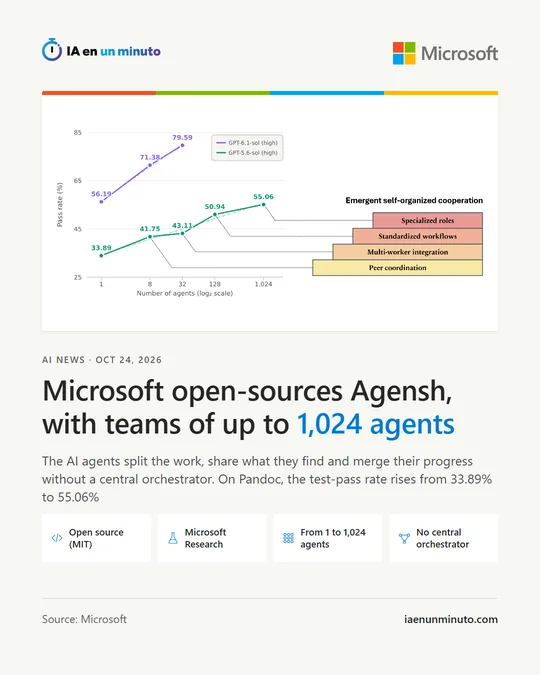
Agensh, Microsoft Research's system for getting many AI agents to program together, now has its code open on GitHub under the MIT license. The agents split the work among themselves with no central boss, relying on a common workspace, messages and a log of findings. On Pandoc, 1,024 agents passed 55.06% of the tests in six hours, against 33.89% for a single one.
On Saturday, October 24, according to its repository, Microsoft Research released on GitHub the code for Agensh, a system that lets many AI agents program as a team without a central agent handing out the tasks. It comes under the MIT license, as open source, in a version 1.0 that contains the system itself, the programs for launching the experiments and a guide for reproducing them.
The study that introduced Agensh came out on September 22 on arXiv, signed by seven Microsoft Research researchers. Its authors explain that today's multi-agent systems tend to hit a limit at the central coordinator, which is the one that assigns the work and directs the rest.
In Agensh, each agent looks for a piece of the task and takes it on, shares what it discovers, checks the results and adds its progress to everyone else's without waiting for anyone. To coordinate, they use three pieces: a shared workspace with what has been proposed, what is under way and what is finished (built on Gitea); a messaging system (Mattermost); and a common context that keeps reusable findings and what each agent plans to do. In the experiments, each agent runs on GitHub's Copilot CLI.
To measure it, the authors picked the five hardest tasks in ProgramBench, which ask for programs to be rebuilt from how they behave and from the documentation that comes with them. They used GPT-5.6-sol with a high reasoning effort setting, six hours to finish and no Internet connection at all. With 128 agents, the average share of tests passed went up from 19.31% with a single one to 28.78%, a relative gain of roughly 49%. Bigger teams got to similar results earlier.
On Pandoc, the document converter, the share of tests passed went from 33.89% with 1 agent to 50.94% with 128 and 55.06% with 1,024, always within six hours. The repository adds a figure that was not in the study: with GPT-6.1-sol, the newest model, the Pandoc result goes from 56.19% with 1 agent to 79.59% with 32, a relative gain of 41.64%.
According to the authors, as the team grows, coordination between agents, ways of working to merge changes and specialized roles appear on their own, little by little. The released version makes it possible to set up a team on a single machine with Docker Compose and to run a lone agent as a point of comparison. The repository does not mention any commercial product or prices.
Why it matters · analysis and opinion
Until now, running more agents at once usually ran into a bottleneck: the agent that hands out the work. Agensh proposes removing it and letting the team organize itself, and with the code open anyone can check whether the results hold up outside Microsoft's labs. There is still a long way to go before everyday use: the tests are specific programming tasks, with a fixed deadline and no Internet, and the repository does not say how much it costs to keep hundreds of agents working for hours. For a technical team, the useful part right now is the reproduction guide, which makes it possible to measure on a single machine whether splitting a job among several agents pays off compared with just one.
Official source: Microsoft · Written with the help of AI: how we make the news