Denmark moves forward with a reform to ban spreading deepfakes of a person's voice and face without their consent
IA en un minuto newsroom · Editor: Jon Elgezabal
In 30 seconds
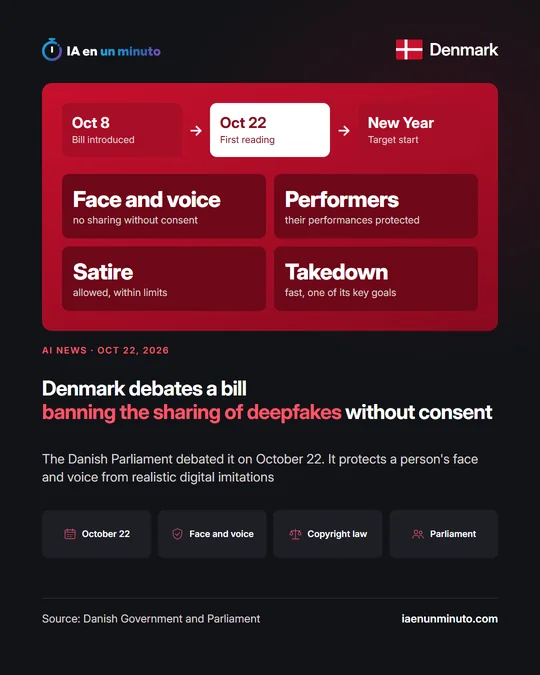
Denmark wants to make it illegal to share, without permission, a realistic digital imitation of someone's face or voice, and the same goes for artists. Zenia Stampe's bill cleared its initial debate in the Folketing on October 22 and is now being examined by a committee. There is room for satire and parody unless the imitation is dangerous disinformation, and the minister hopes the rules apply once the year turns.
On Thursday, October 22, the Danish Parliament (Folketing) held the first reading of the bill that bans sharing deepfakes (realistic digital imitations) of a person's face and voice without their consent. After that debate, according to the Folketing's open data, the bill, numbered L 49, was referred to committee.
Culture Minister Zenia Stampe introduced it on October 8. It amends Denmark's copyright law and, according to the Ministry of Culture, protects any individual as well as artists, whose performances cannot be imitated and shared without their permission either. The text also extends protection to artists' performances that are not artistic works, such as improvisations.
There is an exception for caricature, parody, satire and criticism of those in power and of society: in those cases, some imitations may be shared without consent. The exception does not apply if the imitation is disinformation that could seriously endanger other people's rights or important interests, or pose a concrete danger to life or property.
"Now we are stopping digital identity theft and helping the artists whose livelihoods are under threat," Stampe said when presenting it. The minister said one of the main goals is for big tech companies to take manipulated content down quickly, so it does as little harm as possible, and expressed hope that the law can take effect at the turn of the year.
The reform includes another change: in disputes over rights payments, if one of the parties asks for it, the case will have to go first to the Ophavsretslicensnævnet (the Danish copyright licensing board) and cannot be taken to court at the same time.
The bill implements the political agreement of June 26, 2025, between the then government (the Social Democrats, the liberal Venstre party and the Moderates) and six other parties. That agreement set out two protections: a general one against realistic digital imitations of personal characteristics, and a specific one for performing artists. The law has not yet been passed.
Why it matters · analysis and opinion
The route chosen is what stands out: Denmark is not creating a separate AI law but extending its copyright law, so that anyone's face and voice get protection similar to that of a creative work. The ban falls on whoever spreads the imitation, and the practical pressure on the big platforms, which would have to take it down quickly. There is still a long way to go before it can be seen working: the text is still in committee, the start date is only the minister's hope, and the line between satire and dangerous disinformation will be drawn case by case. Anyone using synthetic voices or faces in ads, videos or customer service can get ahead now by keeping written permission from each person imitated.
Official source: Danish Ministry of Culture · Written with the help of AI: how we make the news