Canva launches its own AI image generator to compete with Google and OpenAI
IA en un minuto newsroom · Editor: Jon Elgezabal
In 30 seconds
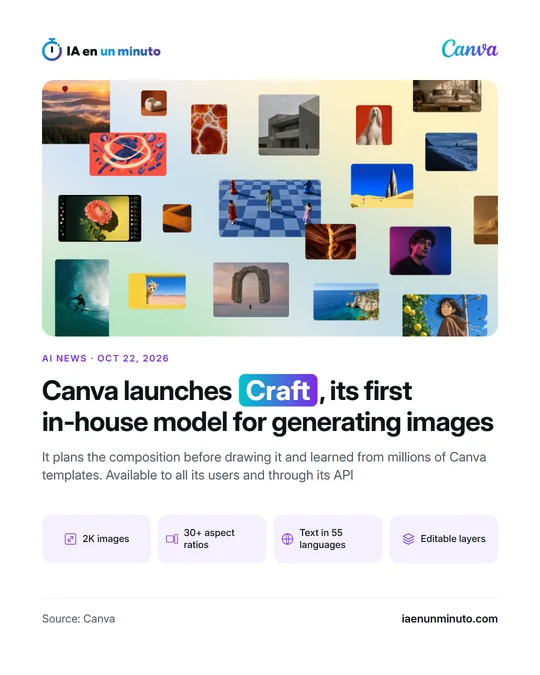
Canva is rolling out Craft, an image model built by its Canva Research lab and already open to any user from Dream Lab and to developers through the API. Craft first draws up a plan of the composition and then renders the image, having been trained mostly on design templates. The company is also announcing two faster, lower-cost variants and support in its MCP server.
On Thursday, October 22, Canva introduced Canva Craft, its first image generation model, developed and trained from scratch by Canva Research, its AI lab. All Canva users worldwide can already use it from Dream Lab, in the bottom-left panel, and developers can reach it through its public API (the connection for using it from other software). According to TechCrunch, Canva built it to compete with image models from Google, OpenAI, ByteDance and Meta.
Unlike models that produce the image straight from the request, Craft works in two stages. First, one model writes a plan of the composition: which elements appear, where they go, at what size and what text they carry. Then a second model turns that plan into an image of up to 2K resolution, in more than 30 aspect ratios or one set by the user. Canva says this lets it place objects more accurately and write legible text, and lets users change a single element without touching the rest of the image.
Its training gives more weight to design than to photographs: it includes millions of human-made templates from Canva's library, such as posters, social media posts, presentations, infographics and menus. The company then fine-tuned it using ratings from its professional designers. It can be prompted in any language, writes text in 55 languages, and its images can be turned into editable layers with Magic Layers, the Canva tool that separates the elements of an image.
According to Canva, Craft debuted as the fourth-best image model on DesignArena, the largest AI design ranking based on user votes, and first for portraits of people (out of 87 models) and for landscapes and nature (out of 85). In the same ranking it places second for abstracts and patterns, and fourth for products.
Until now, Canva generated images with several models, TechCrunch notes, adding that the company bought the generation platform Leonardo.ai in 2024 and that its researchers worked on Craft. According to the same outlet, Canva says that, beyond cost, having its own model gives it better control over quality and speed.
The company is preparing two faster variants, Craft-fast and Craft-ultrafast, designed to cost a fraction of what the most advanced models do. Craft will also soon come to its MCP server (the system that connects Canva to AI assistants and agents), so they can create images ready to use in a design; according to TechCrunch, that opens the door to generating them from other companies' assistants, such as ChatGPT or Gemini. The announcement does not include pricing. Canva says it will keep improving the model, for example with fine print and technical drawings.
Why it matters · analysis and opinion
The move changes Canva's role: until now it relied on several image models, and as of this week it competes with them with one of its own. The bet lies in the training material: mainstream generators learn mostly from photographs, and text and composition are exactly what shows most in a poster or a menu. Judging it still requires everyday use: the ranking Canva cites is based on votes, and the announcement does not say what using it through the API will cost. Anyone who makes posters, menus or social media posts can try it now in Dream Lab with their usual jobs and check two things: whether the text comes out spelled correctly and whether the resulting layers can be adjusted without redoing the design.
Official source: Canva · Written with the help of AI: how we make the news