IA en un minutoNewsBusiness and products
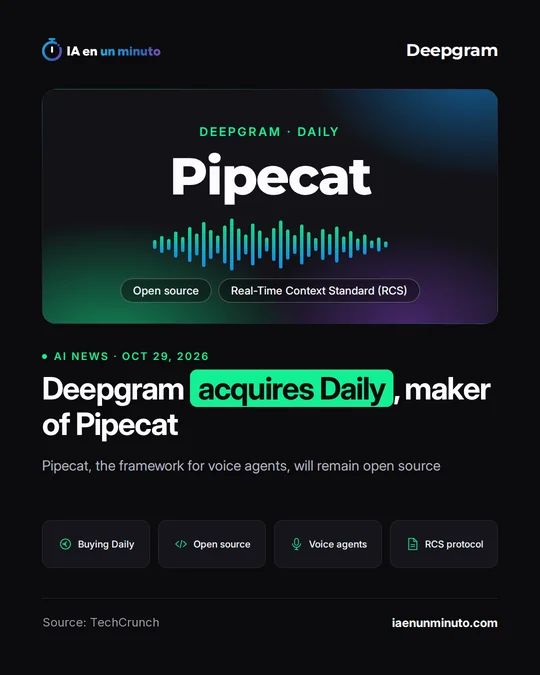
Deepgram acquires Daily, the company behind Pipecat, the open framework for voice agents
IA en un minuto newsroom · Editor: Jon Elgezabal
In 30 seconds
Deepgram is taking over Daily, the company responsible for Pipecat, an open framework for building voice agents that links transcription, language models and speech synthesis. The price was not given, although both sides promise Pipecat will stay open. Alongside the deal comes RCS, an open protocol created with the Pipecat team to pass audio context, such as a whisper, to the agent.
Deepgram announced on Thursday, October 29, that it is acquiring Daily, the company that created and maintains Pipecat, one of the most popular open source infrastructures for voice AI. According to TechCrunch, the sector is going through a phase of consolidation, with companies trying to strengthen their position through partnerships and acquisitions, and Deepgram is the latest to make a move. The two companies did not disclose the amount of the deal, but say Pipecat will stay open source.
Pipecat is a framework that handles voice and video streams alongside other pieces of the chain, such as speech-to-text transcription, language models and text-to-speech, while cutting latency. Daily, for its part, runs a hosted platform for voice and video calls. TechCrunch, citing PitchBook data, reports that Daily has raised more than $62 million from investors such as Tiger Global and Highfield Capital, and that Deepgram reached unicorn status this year with a $130 million Series C round; it adds that both companies came out of Y Combinator's 2016 batch.
Daily co-founder Kwindla Kramer told TechCrunch that, although there was plenty of buying interest, he favored Deepgram because its chief executive, Scott Stephenson, committed to keeping Pipecat open and vendor-neutral "forever", and because the engineering cultures of the two companies matched. Stephenson says he wants anyone to be able to build voice agents with the models that suit them best, whether or not they come from Deepgram, and that if the company sees it has ground to make up in some area, it will work to improve there.
Alongside the deal, Deepgram is introducing Real-Time Context Standard (RCS), an open protocol for voice agents built with the Pipecat team. It defines metadata such as audio context, for example a whisper, plus directions for the language model on putting that information to use and a note on the tone the reply should have.
Why it matters · analysis and opinion
The purchase leaves a voice-model company owning a piece that others use to assemble their own agents, which is why the promise to keep Pipecat open is the part that will be watched most closely. For anyone building voice agents, the practical question is how far the framework will stay neutral toward rival vendors; Deepgram itself says it wants the best models to be used, whether they are its own or not. The RCS protocol points to another gap: letting the agent know how something was said, not only what was said. The price and how the project will fit inside Deepgram are still unknown. Meanwhile, anyone already using Pipecat would do well to follow both companies' announcements.
Source: TechCrunch · Written with the help of AI: how we make the news