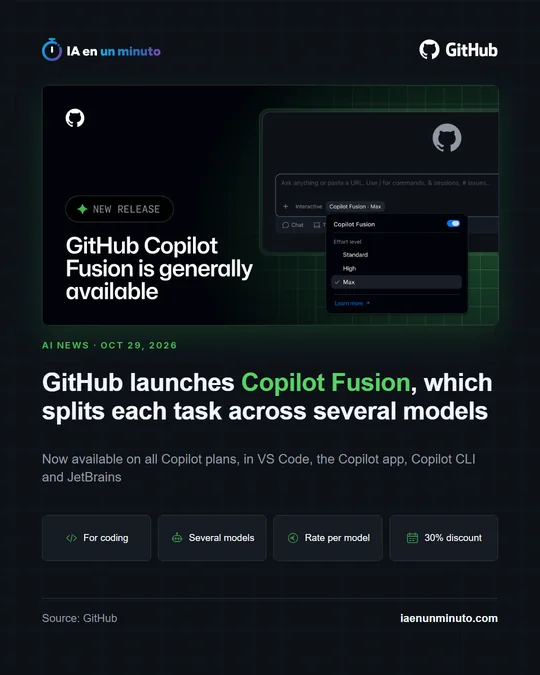
GitHub launches Copilot Fusion, which splits each task across several models
IA en un minuto newsroom · Editor: Jon Elgezabal
In 30 seconds
GitHub has released Copilot Fusion, a Copilot option in which the system, not the programmer, chooses which models handle each task. There are three effort levels and three ways of working, among them a cascade that moves up to a bigger model if the quality check fails and a cross-review between two models. Each model is paid at its own rate and, for now, paid plans get a 30% discount.
GitHub introduced Copilot Fusion on October 28 at its GitHub Universe conference. It is an option in Copilot's model picker that, instead of relying on one model, decides for each request which models to use and how to combine them. According to GitHub's announcement, it is now generally available in Visual Studio Code, the GitHub Copilot app, Copilot CLI and JetBrains IDEs, on every Copilot plan, with more clients to follow soon.
Fusion merges two earlier pieces: the multi-model orchestration of Project HydraFusion and the model selection of Copilot's auto mode. Those who took part in the research preview will see their choices carried over to the new levels. There are three effort levels: Standard, for everyday work with versatile models; High, for harder tasks that call for deeper reasoning; and Max, which leans on the strongest models for the toughest jobs. Depending on the task, it works in one of three ways: a single model; a cascade, in which an efficient model drafts and, if the draft fails a quality check, the job moves up to a stronger one; or a critique, in which one model drafts, another reviews it and the first revises.
Administrators decide which models Fusion can use: it only draws on those enabled in the enterprise and organization policies, and it can be set as the default model through Enterprise managed settings. Each model used is billed at its standard rate and, for a limited time, paid plans get 30% off the model costs of Fusion sessions. Hari Pokhrel, a principal software engineer at AT&T, says in GitHub's post that Fusion Standard has improved token efficiency across the company.
According to GitHub, Fusion Max scored 60 points on the Artificial Analysis Coding Agent Index, two points behind Claude Code running Opus 5.5 Max, at roughly half the average API cost per task, roughly half the tokens and about 40% less time per task. These are the company's own figures. Per The Next Web, Microsoft chief executive Satya Nadella wrote on LinkedIn that Fusion reaches frontier-level quality while running 40% faster and costing up to 77% less. The same day, GitHub published its Octoverse report, which says that agents wrote the first draft of more than 40% of pull requests by September, against 17% in March.
Why it matters · analysis and opinion
Until now, choosing a model was each programmer's decision and, over time, each invoice's. Fusion moves that choice to the system itself, and that matters for two reasons: it reduces the slip of leaving the costliest model on for trivial tasks, as AT&T describes, and it turns Copilot into the one that arbitrates between models. The performance and cost figures, though, come from GitHub and measure a single index; it is worth testing it on your own code before taking it as given. Anyone already paying for Copilot can use the temporary discount to compare spending with and without Fusion, and administrators keep control over which models come into play.
Official source: GitHub · Written with the help of AI: how we make the news