Anthropic launches a gallery of interactive Claude tools for legal teams
IA en un minuto newsroom · Editor: Jon Elgezabal
In 30 seconds
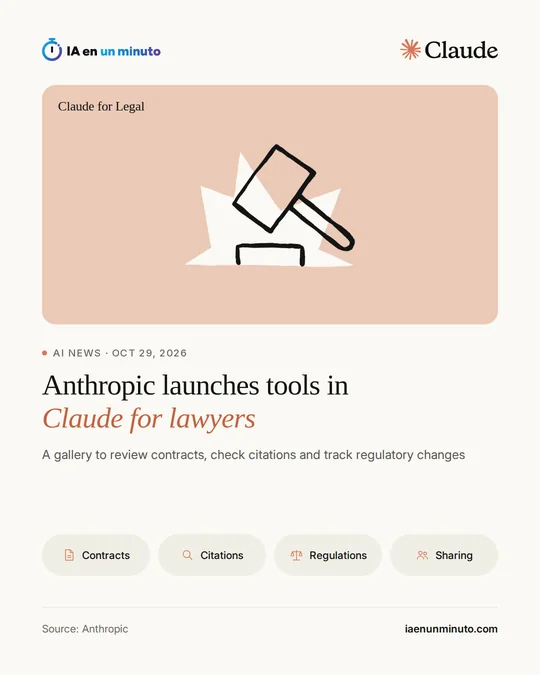
Anthropic has opened a gallery of artifacts inside Claude for Legal: interactive tools that each team adapts to its own data and shares with the business. They help review batches of contracts, check citations or watch for upcoming rules, and every result links to its source. Goodwin, Harvey, Foley & Lardner and PwC contributed pieces, and the split is clear: Claude does the first pass and the lawyer decides.
Anthropic introduced a gallery of artifacts for Claude for Legal on October 28, the offering for legal professionals it launched in May. According to the company's announcement, legal teams have mostly asked for an easier setup and smoother ways of working with colleagues since then. Artifacts are interactive tools (trackers and dashboards, for instance) that are used and shared inside Claude, and each one opens with an example so users can see how it works before adding their own data and connectors.
The gallery includes six general-purpose artifacts from Anthropic. The first verifies citations: it checks a brief against its sources and flags quotes that do not match or point to the wrong page. The second, a jurisdiction matrix, compares how each state or country regulates the same issue, for example breach notification, with links to the law. Another board gathers engagement letters, emails or spreadsheets and shows the open matters with their owner, next step and next deadline. A fourth sets contracts against the company's usual template and points out clauses that differ. The fifth is a timeline of upcoming regulation ranked by impact, and the sixth a tabular review of a set of contracts. Each answer links to its source.
Among the partner artifacts are Goodwin's, which gauges how a company handles AI governance to spot gaps, and Foley & Lardner's, which goes over each party's obligations in an agreement before and after closing. Harvey contributes Harvey Intake, an inbox inside Claude where the rest of the business sends legal questions: routine ones are answered from the legal team's own guidance and the others go to a lawyer. PwC offers a tool that turns precedents, standard objections and templates into first drafts of replies to subpoenas. Legora and Orrick will announce theirs later.
Anthropic says that since launching Claude for Legal it has added over 60 connectors to legal tools; Bloomberg Law, Filevine, Ivo, Legora and Patlytics are among them. It is also funding public-interest groups that build access-to-justice artifacts and training programs that teach future lawyers to work with Claude, and it has opened a waitlist for the Legal Ambassadors Program, a community where professionals swap work and learn from one another. The company describes the split this way: the professional supplies documents and sources, Claude takes a first look, and the final judgment stays with the lawyer.
According to Diario TI, which relays what the specialist outlet Artificial Lawyer says, Anthropic supplies models to firms such as Harvey, Legora, Thomson Reuters and LexisNexis while giving lawyers features that resemble those companies' own. The same outlet adds that there is no separate legal model: Claude for Legal is Claude accompanied by skills, connectors and workflows prepared in advance.
Why it matters · analysis and opinion
What the gallery changes is the starting point: instead of building a tool from scratch, a legal team can open one that already exists, try it with its example and adapt it. The fact that law firms and vendors that also compete with Anthropic take part says a lot about where the legal market is heading: Claude as a platform on which others publish. It remains to be seen how much real work holds up without review; the company itself leaves the final decision to the lawyer, and the source gives no prices or details on which plans or countries it is available in. For a small firm, the sensible course is to try one repetitive task, always check the links back to the source and review the sharing settings before sending anything to clients.
Official source: Anthropic · Written with the help of AI: how we make the news
What does it mean for your business? · analysis and opinion
This news mainly matters to small law firms, freelance lawyers and companies in Spain and Latin America with one person or a small team handling legal matters who already work with Claude. For anyone not involved in legal work, or not using Claude, nothing changes for now. The source gives no prices and does not say in which countries or plans Claude for Legal is available, so it is worth checking before relying on it.
In practice, the sensible approach is to start with a single repetitive task, such as reviewing a stack of contracts or checking that the citations in a document match their sources, and to try the example that comes with each artifact before uploading your own documents. Our advice is to always open the source links attached to each output and review flagged items by hand, because Anthropic itself presents Claude as a first pass and leaves the final decision to the lawyer.
The main risk lies in the data: contracts and case files usually contain personal and confidential client information. It is worth reviewing the sharing settings before sending an artifact to colleagues, clients or partners, and limiting who can see it. And if other tools are linked through connectors, it pays to grant access only to the folders that are strictly needed.