Anthropic launches smart reports, surveys and pooled budgets for Claude Enterprise
IA en un minuto newsroom · Editor: Jon Elgezabal
In 30 seconds
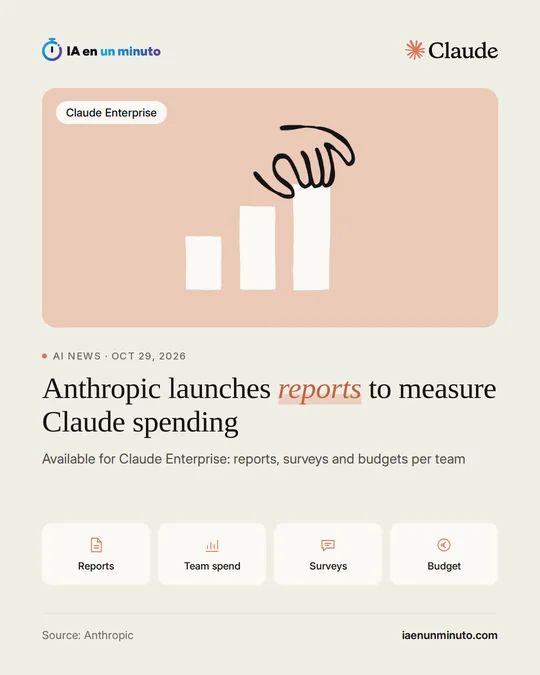
Anthropic is adding three tools to Claude Enterprise to show what each team does with the assistant and what it costs the company. The reports sort the work into workstreams with their spend and their bottlenecks, and end with recommendations; Anthropic warns they are not meant for judging one person. Surveys ask the team for its own view, and group budgets set one shared monthly cap.
Anthropic has announced three tools for Claude Enterprise, the business edition of Claude, that let an organization see what its teams get done with the assistant and what that work costs. It presented them on October 28 on its blog, and they are now generally available, although availability varies by configuration, for example in organizations with a HIPAA setup or customer-managed encryption keys.
Smart reports start from a team, a period and the products to include. Claude reviews a sample of the team's conversations and sorts them into workstreams; for each one it reports the spend, what was delivered and the most frequent friction points, for instance a connector that is absent or a failing tool call. Every report ends with a single list of recommendations, among them repeated workflows worth turning into skills and rules to add to the code repository. Owners can let team leads without admin rights generate reports for their own groups. Anthropic makes clear that the reports are meant for understanding adoption and planning investment, not for judging how any one person performs or for decisions about their employment.
In-app surveys gather the team's own view. The default questions center on value: the most useful thing someone has done with Claude lately, how much it altered the time that work needed, which use a teammate ought to imitate, and what would break or slow down first if the team lost access tomorrow. Admins can edit or drop questions, choose who gets the survey and when, and export the answers to a spreadsheet. Staff meet it as a brief card that appears after a reply, in the very tool they are already using.
A pooled group budget is a single monthly allowance shared by the whole group, which makes it less likely that heavy users hit their own cap in the first weeks while teammates leave theirs untouched. Individual limits stay as a safeguard against unusually high use: each request counts against both, and the person is stopped by whichever is exhausted first. A person who hits a limit can request more without leaving Claude; admins review the request. When a budget is set up, Claude proposes an amount based on how much the group has used lately, and admins with billing permissions are notified by email when 50%, 75%, 95% and 100% of the budget is reached.
According to TechCrunch, with these tools Anthropic is trying to show the return on investment of its products, a major worry for the large companies that buy them, and the company says it will not use this data to train models by default. The outlet also cites a report from Jellyfish, which says spending on agentic coding tools has grown tenfold since the start of the year and now amounts to roughly 2% of total engineering cost.
Why it matters · analysis and opinion
Measuring what AI spending delivers has become a question for management, not only for technical teams, and Anthropic answers with tools that look at real use instead of assumptions. The interesting part is the order of the pieces: first see the work, then ask the people who do it, and finally split the budget. A company that has Claude Enterprise can start with one team and compare what the report says with what the survey tells. It also helps to decide in advance how to explain to staff that a sample of their conversations is analyzed, and to respect the limit Anthropic itself sets: no using the results to judge a person. For every other company, the lesson is to keep track of which task is automated and with what result.
Official source: Anthropic · Written with the help of AI: how we make the news
What does it mean for your business? · analysis and opinion
This update only reaches organizations that already pay for Claude Enterprise, the version of Claude for businesses. The announcement does not mention other plans, so freelancers or small businesses using Claude on a different subscription should not count on these tools for now. In Spain and Latin America, it makes the most sense for companies with several teams that already work with Claude every day and want to know where the money goes.
In practice, the admin picks a team, a date range and the products to review, and the report groups the work into workstreams, with their spend, what was produced and where things get stuck, for example because of a missing connector. Our advice is to start with a single team, review the recommendations before expanding usage, and rely on pooled group budgets to set a cap per team instead of monitoring person by person.
The risk lies in how the data about staff is used. The reports draw on a sample of real conversations, and Anthropic makes clear that they are not meant for evaluating individual performance or making employment decisions. The sensible approach is to respect that limit, tell the team that their conversations may be analyzed, and be careful about which findings are shared and with whom. According to TechCrunch, Anthropic will not use this data to train its models by default.