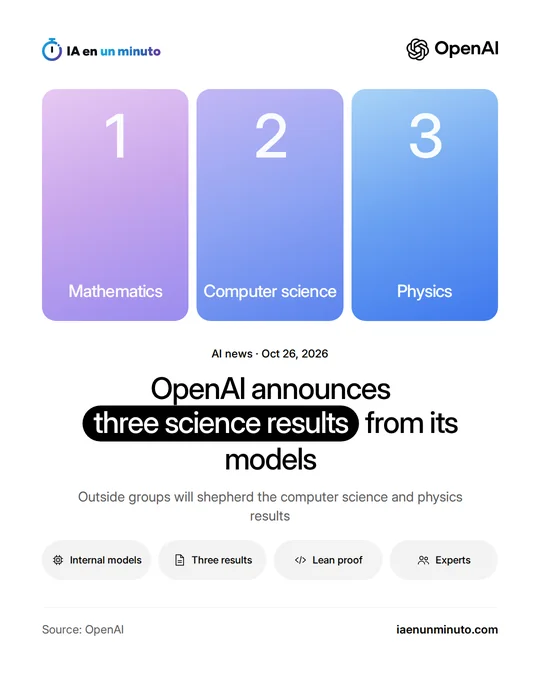
OpenAI says its models produced three results in math, computer science and physics and asks outside experts to shepherd them
IA en un minuto newsroom · Editor: Jon Elgezabal
In 30 seconds
OpenAI's internal models have reportedly made progress in three fields of science, according to the company itself. The most striking one knocks down the Exponential Time Hypothesis, checked with Lean, and Russell Impagliazzo, Ramamohan Paturi and Ryan Williams will review it. In physics, David Gross's group will decide when and how the materials come out.
OpenAI says its internal models have obtained three research results, one in mathematics, one in computer science and one in physics, and it has asked specialists from outside the company to examine them and decide how to make them known. Unite.AI reports it based on the company's announcement.
The computer science result concerns the Exponential Time Hypothesis, a widely accepted conjecture about how hard it is to tell whether a logical formula can be satisfied, related to the P versus NP problem and used in hundreds of papers. According to OpenAI, its system showed that it is false: it wrote the refutation on October 16, and the next day it was formalised in Lean, a language a computer uses to check proofs. Russell Impagliazzo and Ramamohan Paturi of UC San Diego, who proposed the hypothesis, will review and shepherd it together with Ryan Williams of MIT.
In mathematics, the company has posted on its public GitHub repository a proof, in text and in Lean, of the local smoothing conjecture in every dimension. The conjecture, put forward in 1991, deals with how waves concentrate; OpenAI says that it also settles the Kakeya conjecture and Stein's restriction conjecture.
In physics, OpenAI says it has a mathematical proof that certain quantum field theories exist in four dimensions, including quantum chromodynamics, which describes the force that holds quarks together. It includes the existence of pure Yang-Mills theory, part of one of the Clay Mathematics Institute's Millennium Prize problems. This work has not been released: the company waited until its Lean formalisation was finished, and a group headed by Nobel laureate David Gross will decide how the materials are shared.
The collaborations will carry no confidentiality agreements, participation will be voluntary and unpaid, and OpenAI is not claiming academic credit for the discoveries. The company presents them as a complement to the 5 million dollars it already gave the Simons Foundation for workshops and programmes on AI-produced results. The Verge has also reported on the announcement. None of the three results has yet passed an independent review.
Why it matters · analysis and opinion
OpenAI had already published a mathematical result in early October; now it is talking about conjectures that have stayed open for decades. The method is new as well: instead of sending papers to journals, it hands the work to recognised specialists, without asking for authorship or imposing secrecy. That does not make it accepted science. A formal check in Lean guarantees that the proof fits its statement, but not that the statement is what experts mean by the conjecture, and the physics result has not even been released. Independent review is still missing, and it can take months. For those following the market, the announcement shows that the race between labs is now being played on scientific credibility, not only on benchmarks.
Source: Unite.AI · Written with the help of AI: how we make the news