OpenAI launches GPT-6.1 Terra, a faster and cheaper model for using the computer
IA en un minuto newsroom · Editor: Jon Elgezabal
In 30 seconds
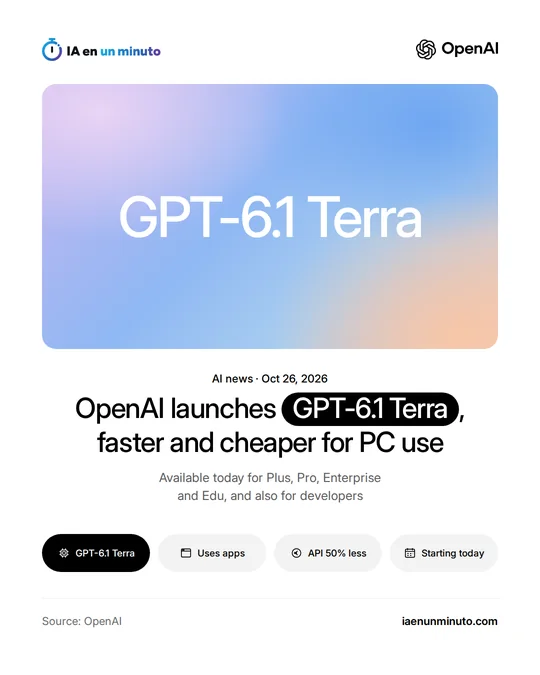
OpenAI is rolling out GPT-6.1 Terra, its new model for letting AI operate the computer: it reads the screen and moves between programs for jobs such as forms or invoices. Since October 26 it reaches anyone paying for Plus, Pro, Enterprise or Edu, and programmers pay half as much in the API as for its predecessor, GPT-5.6 Terra. Its best results come from tests run by OpenAI itself.
OpenAI unveiled GPT-6.1 Terra on Monday, October 26: a fast, efficient model designed to operate the computer at a lower cost.
The company explains that the model interprets what it sees on screen and works across different applications. Among the uses it gives as examples are filling in forms, drafting proposals, interpreting technical drawings or reading incoming invoices and moving their details into the accounting program. It replaces GPT-5.6 Terra, which OpenAI says it clearly outperforms.
To measure how it operates the computer, OpenAI used Agents' Last Exam, a set of professional tasks for AI agents. At a medium reasoning level, GPT-6.1 Terra gets 15 percentage points more than GPT-5.6 Terra at roughly a third of its cost. The company adds that it completes tasks over three times faster than GPT-6 Astra and GPT-6.1 Sol, its most powerful models, which remain its recommended choice for the most complex programming. All of these tests were run by OpenAI itself.
It can already be used in ChatGPT Work and Codex on the Plus, Pro, Enterprise and Edu plans, and developers have it in the API as gpt-6.1-terra. There it costs $1 per million input tokens, $0.05 when the input is cached and $5 per million output tokens: half the price of GPT-5.6 Terra and GPT-6.1 Sol.
Why it matters · analysis and opinion
Until now, handing screen work to an agent was expensive and slow, and that held back any large-scale use. Terra goes straight at that point: it does not promise OpenAI's smartest model, but one that is good enough and cheap for repetitive tasks such as moving invoices into accounting. It is also a message to competitors, because the agent race is starting to be fought on price per task. What is missing for real-world use is proof outside the lab: the measurements are in-house, and in processes involving money or customer data a mistake costs more than what is saved. Anyone who wants to try it can start with a narrow task with human review.
Official source: OpenAI · Written with the help of AI: how we make the news
What does it mean for your business? · analysis and opinion
This launch matters mainly to freelancers and small businesses in Spain and Latin America that already pay for a ChatGPT Plus, Pro, Enterprise or Edu plan, and to anyone running their own tools on the OpenAI API. The free plan is not among those getting the model, so people who do not pay will not see any change for now. For anyone automating repetitive admin work, such as moving invoice data into a spreadsheet or filling in forms, a price of $1 per million input tokens and $5 per million output tokens makes testing considerably cheaper.
Our advice is to start with a small task that is easy to measure: pick a modest batch of documents that have already been processed by hand, ask the model to do the same work and compare the results one by one before trusting it with more. It is wise to let the agent run on an account or a computer with no access to banking or payments, and to have a person check every submission before accepting it.
The main risk is taking for granted improvements that only OpenAI itself has measured. A wrongly copied amount or tax ID in the accounts can be costly. Invoices also contain personal data about customers and suppliers, so the prudent step is to check the data processing terms of the plan you use before uploading them.