Cadence launches NVIDIA-backed AI models that chipmakers can run on their own premises
IA en un minuto newsroom · Editor: Jon Elgezabal
In 30 seconds
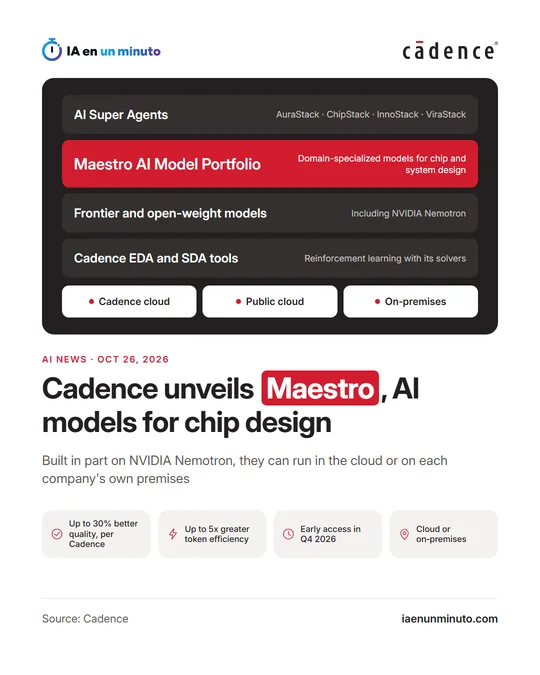
Cadence is launching Maestro, a family of AI models designed for chip design that put its engineering agents to work. The models lean in part on NVIDIA's Nemotron, and each company can use them in the cloud or in its own data centers and fine-tune them with its designs. According to Cadence itself, they deliver up to 30% higher quality and up to 5 times better token efficiency.
Cadence Design Systems, one of the major chip design software companies, on Monday, October 26, presented Maestro, a portfolio of AI models specialized in designing chips and electronic systems. The models serve its AI Super Agents (AuraStack, ChipStack, InnoStack and ViraStack), agents that start from a general goal, work out what is to be designed, split the work into tasks and operate Cadence's own design tools.
Maestro brings together models of several sizes and architectures: large language models tuned for this field, trained decision models and agent skills that keep improving on their own. According to Reuters, in the story carried by US News, it was built in part on Nemotron, NVIDIA's open-weight model. The two companies are also collaborating on agent security with OpenShell, NVIDIA's reference architecture for protecting them. The agents combine Maestro with other leading and open-weight models, and each customer can keep training the models on its own data, designs and workflows.
The whole environment can run in Cadence's cloud, in public clouds or in the customer's own data centers, to meet its privacy and security requirements. Cadence says that, in its first tests with design workflows, Maestro improves the quality of results by up to 30% and is up to 5 times more token-efficient (it needs to process less text for the same task) than a general-purpose foundation model. These are the company's own figures, and it attributes the gain to reinforcement training in which its design tools check every result.
Among the customers Cadence cites, Socionext explains that it is bringing the InnoStack agent into its production design environment and expects up to a fivefold productivity gain without losing quality.
According to Reuters, the approach contrasts with that of Synopsys, its largest competitor, which on September 30 announced it will develop a model with OpenAI, GPT-Synopsys, that will run on OpenAI's infrastructure and whose revenue it will share with it. Paul Cunningham, a Cadence senior vice president, told Reuters that Maestro does not depend on a single model provider and that working with commercial AI labs is also part of its plans, though he gave no further details.
The first Maestro models will reach some customers, in early access, in the fourth quarter of 2026. Cadence has not given prices.
Why it matters · analysis and opinion
What sets Cadence apart from its big rival is not so much the quality of the models as the place where they live. For anyone who designs chips, the design is their most valuable asset, and being able to run the AI in-house and fine-tune it with their own data removes one of the major objections to adopting it. It also says something about the market: the two leading names in design software have now picked sides, one alongside OpenAI and its infrastructure, the other alongside NVIDIA and open models. What will decide adoption is still unknown: the price, what it costs to keep all this on one's own premises and whether the gains the company announces hold up in real customer projects, outside its own tests.
Official source: Cadence · Written with the help of AI: how we make the news