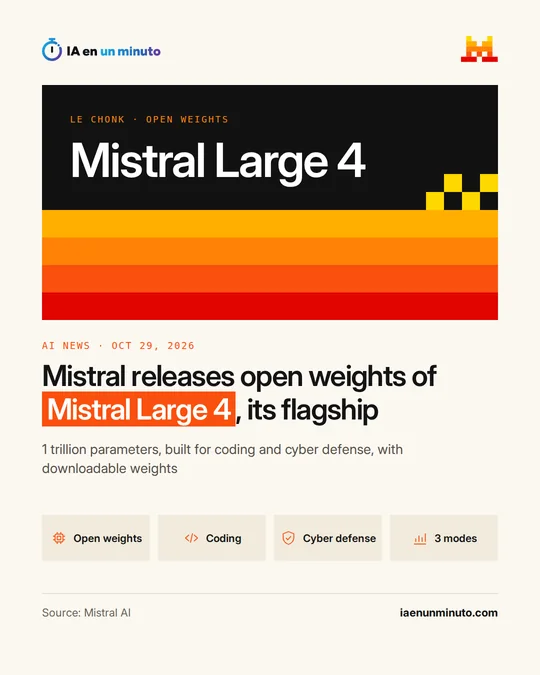
Mistral AI releases the open weights of Mistral Large 4, its model with 1 trillion parameters for coding and cyber defense
IA en un minuto newsroom · Editor: Jon Elgezabal
In 30 seconds
Mistral AI has made Mistral Large 4 openly downloadable: the model with 1 trillion parameters that it unveiled in preview earlier this month. The company says another three weeks of reinforcement learning improved its coding, with 41% on Terminal-Bench 4.0, and its defensive cybersecurity, which reaches 51% in the measurement by Artificial Analysis. Mistral adds that, on average, it stops 96.6% of malicious cybersecurity prompts.
Mistral AI released the weights of Mistral Large 4 today. It is the company's flagship model, which it calls Le Chonk.
The model has 1 trillion parameters and is natively multimodal; the company unveiled it in public preview earlier this month. With the weights out, there are now options to run it on one's own servers. According to Mistral, three more weeks of reinforcement learning have lifted its coding: on Terminal-Bench 4.0 (a terminal-based coding test) it gains 13 points, reaching 41%. In defensive cybersecurity (finding and fixing vulnerabilities), it scores 51% on the Artificial Analysis index, according to Mistral's official page.
According to Hugging Face, which hosts it on its platform, it is a mixture-of-experts model with roughly 1 trillion parameters in total, 49 billion of them active, and a context window of one million tokens. There are two official variants, FP8 and NVFP4, and it ships under the Mistral Ecosystem Open-Weight License, derived from the MIT license, which restricts model-as-a-service offerings. It works from day one with transformers, vLLM and llama.cpp, and it can also be deployed remotely through Hugging Face's services.
It now has three reasoning modes (low, medium and high) to balance performance and cost. The company says that, on average, it declines 96.6% of malicious cybersecurity requests, the highest figure it measures among open models, and that it was trained from scratch on European infrastructure.
Mistral acknowledges that, since the preview, it has watched how the model is used for cybersecurity in its live traffic: although it refused to help with direct attacks on real targets, it sees potential for facilitating real attacks and is changing its guardrails. It also gives early access, with vetting and contractual safeguards, to partners such as Orange Cyberdefense for a variant specialized in penetration testing, vulnerability assessment and attack simulation.
These figures will need to be checked against independent evaluations.
Why it matters · analysis and opinion
What is new is not just a more powerful model, but who gets to control it. With the weights in hand, a company or an agency decides where it runs, which usage policy applies and what data leaves its network, something a closed API does not allow, even though the license limits offering it as a service to third parties. For security teams it is a way to audit code without depending on a vendor. The other side matters too: Mistral itself admits it sees a risk that the model could help real attacks and is adjusting its guardrails. Until independent evaluations exist, it is wise to test it on one's own cases before trusting its maker's figures, and anyone who does not want to set up servers can turn to the remote deployments that Hugging Face offers.
Official source: Mistral AI · Written with the help of AI: how we make the news