Giotto launches Solo and Alto, its Swiss-built sovereign AI reasoning models
IA en un minuto newsroom · Editor: Jon Elgezabal
In 30 seconds
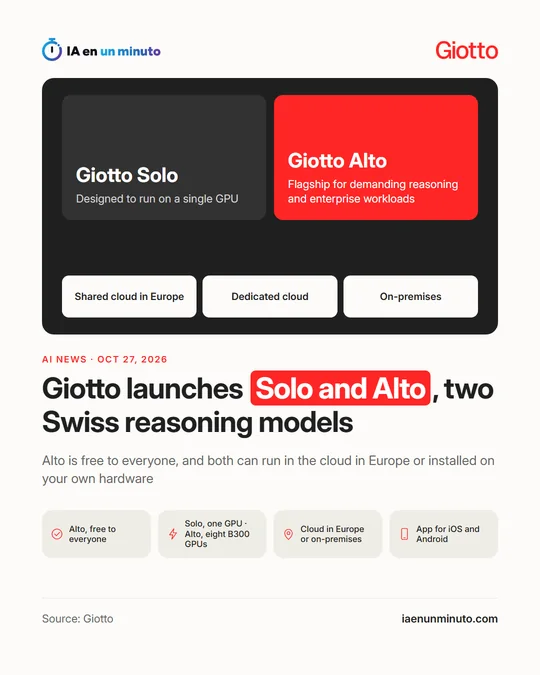
A Swiss AI lab based in Lausanne has released two reasoning models, Giotto Solo and Giotto Alto. The first is meant to fit on a single GPU, while the flagship Alto needs eight B300 chips. Users can run them in a shared or dedicated cloud in Europe, or install them on their own hardware, and Alto is free for everyone.
Giotto, a Swiss artificial intelligence lab headquartered in Lausanne, unveiled two reasoning models on October 27, Giotto Solo and Giotto Alto, both built in Switzerland, according to its press release. The lighter one, Solo, targets setups with a single graphics card. The family's top model, Alto, aimed at heavy reasoning jobs and business use, needs eight B300 cards.
Customers can pick among three setups. One is a shared cloud that Giotto hosts and operates in Europe. Another is a dedicated cloud, kept in isolated environments inside partner data centers in Switzerland or other European countries. The third is installing the software on compatible machines the customer owns, via partner integrators: a workstation with one card is enough for Solo, while Alto calls for server racks with several.
The shared cloud costs nothing to use, and its anonymous chat requires no sign-up. Alto itself is free for everyone. Developers who call the shared cloud through its API pay one flat fee for unlimited requests, though only one can run at a time; extra token bundles cover heavier loads. Dedicated instances start at one card, are rented monthly and come with the software license. Local installs are licensed yearly or for several years, priced by how many GPUs, and which kind, are used. Phone apps for iOS and Android arrive alongside.
The company was founded in Lausanne in 2017 by graduates of EPFL's mathematics program. By its own account, it ranked 11th in the 2024 ARC-AGI contest and second in 2025, among roughly 1,500 teams. CEO and co-founder Aldo Podestà frames the pitch as sovereignty that should rest with those who use AI, not just with those who build it.
Giotto says its cloud services are aligned with GDPR and do not rely on US cloud infrastructure. Those are the company's own claims; the release cites no independent evaluation.
Why it matters · analysis and opinion
The underlying message is sovereignty as a selling point: where the model runs and who controls the data become part of the offer, not a technical detail. For a European organization handling sensitive information, being able to choose between a shared cloud, an isolated environment or its own servers widens the options compared with the big US providers. That said, what is claimed about GDPR and independence from US cloud comes from the company itself, and the release offers no outside evidence or performance comparisons with other models. Before signing up, anyone evaluating it can try the free chat with non-sensitive data and ask in writing where data is hosted and processed in each option.
Source: Giotto · Written with the help of AI: how we make the news