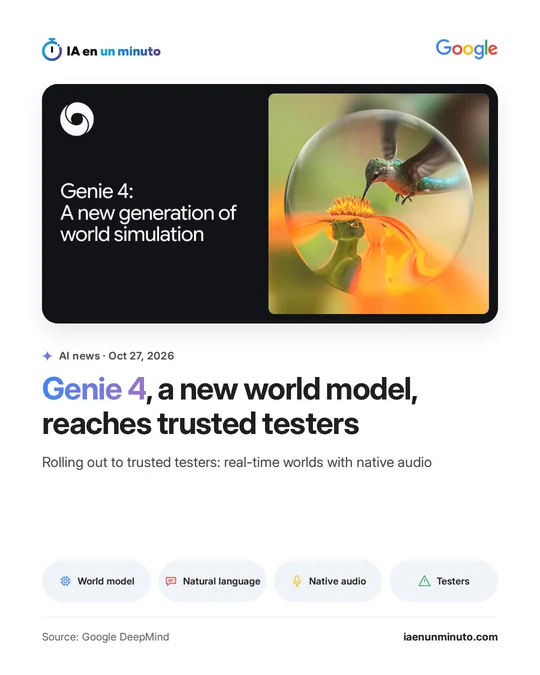
Google DeepMind announces Genie 4, its new world model with native audio, for now only for trusted testers
IA en un minuto newsroom · Editor: Jon Elgezabal
In 30 seconds
DeepMind's new world model simulates interactive scenes in real time, and each one comes with its own sound: ambience, music and dialogue. What happens can be changed by typing commands, such as moving the camera, altering the weather or adding characters. For now only trusted testers are trying it, and it will soon reach Google AI Ultra subscribers and early access partners.
Google DeepMind has presented its research on Genie 4, a world model (a system that simulates interactive environments) that can generate scenes in real time and now includes native audio, according to Google's announcement of October 27.
With Genie 4, a user can set an event in motion and change the scene by typing in natural language: shifting the camera, changing the weather or adding new characters. Each world also produces its own audio on the fly, with ambient sound, music and interactive dialogue. According to Google, the model builds on the Gemini family: Gemini Omni anchors the simulations in the look and behavior of the real world, while other Gemini models supply the reasoning that keeps them coherent.
For now, only a small group of trusted testers is using it, as a research preview. Google plans to open it soon to Google AI Ultra subscribers, inside Project Genie, and to partners with early access to the Gemini API and to Google AI Studio, the company's developer tools.
TechCrunch reports that Genie 3 debuted more than a year ago, also as a research preview, and that Genie 4 can hold a scene together for up to two minutes, double what its predecessor managed. The team concedes that objects and fine details may slip the longer a simulation lasts, and that making the sound accurate and any written text inside the world readable is still unsolved.
Google presents world simulation as a key step toward AGI (artificial general intelligence) and toward safe environments for training robots and agents.
Why it matters · analysis and opinion
What was announced is a research preview, not a finished product: the team itself admits it is not yet clear what the full experience will be. The limits it acknowledges, such as details and objects drifting the longer a simulation runs, audio that is not always reliable and text that is hard to read inside the world, show what is missing for serious use. For game studios, training or robotics, the practical interest lies in testing speed: simulating a scenario and tweaking it with one sentence makes the ideation phase cheaper, but it does not replace a validated environment. While it only reaches testers and Ultra subscribers, anyone who wants to evaluate it can join the waitlist and follow how it develops.
Official source: Google DeepMind · Written with the help of AI: how we make the news