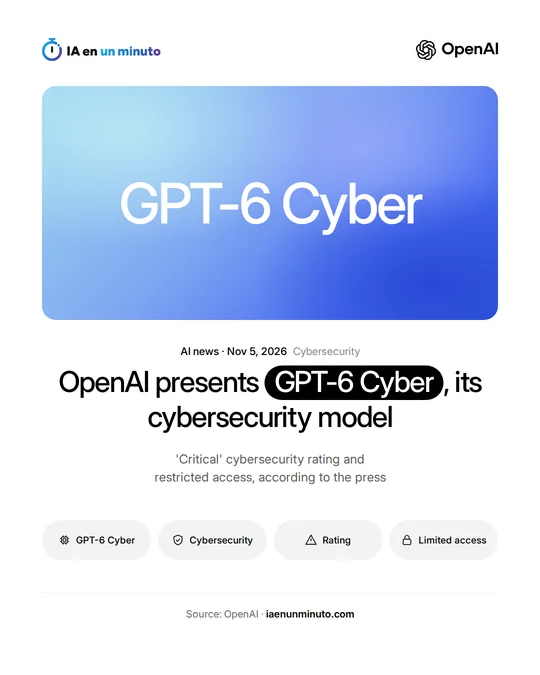
OpenAI Presents GPT-6 Cyber, a Cybersecurity Model With Restricted Access and a "Critical" Cybersecurity Rating
IA en un minuto newsroom · Editor: Jon Elgezabal
In 30 seconds
GPT-6 Cyber is the OpenAI model meant to help security teams locate flaws in programs, prove whether an attacker could take advantage of them and prepare the fix. OpenAI gives it the Critical capability level in cybersecurity, one notch above GPT-5.6 Cyber. Daybreak Red, the OpenAI tier for authorized security testing, offers it only to a chosen group of customers for now, and they must pass identity checks.
OpenAI on November 5 presented GPT-6 Cyber, an AI model specialized in cybersecurity. It has been trained to track down weaknesses in software, check whether they can really be exploited and help fix them, without stepping outside the limits each researcher draws.
Under its Preparedness Framework, OpenAI ranks it at the "Critical" level in cybersecurity, one step above the "High" level that GPT-5.6 Cyber held. According to the company, on ExploitGym, a test that measures whether a model manages to exploit a specific vulnerability, it climbs from its predecessor's 32.1% to 48.5%. OpenAI says its researchers have used it to build 948 privilege-escalation exploits on Linux and to uncover in Firefox 81 high-severity vulnerabilities that nobody knew about; Mozilla has already fixed many of them.
It is not open to everyone. For now, only some approved Daybreak Red customers can use it, through the API and Codex; Daybreak Red is OpenAI's access tier for building exploits and running authorized security tests. The company says it will open it gradually, and soon, to every Daybreak Red customer. Unite.AI explains that applicants go through identity and eligibility checks and commit to authorized uses only, and that OpenAI can limit, suspend or withdraw access when it confirms misuse. OpenAI also requires by default, with few exceptions, that calls to the Daybreak Red API come from approved networks.
Why it matters · analysis and opinion
A model able to build exploits serves defense and attack alike, and OpenAI admits as much by rating it critical in cybersecurity. That is why what matters most about this launch is not only what the model achieves but who can use it and under what oversight: identity checks, approved networks and monitoring of use. OpenAI says it wants to bring this kind of research to organizations of any size, but for now only a few chosen customers are inside, and everyone else will have to wait or make do with general-purpose models. For anyone who maintains software, the practical lesson is different: if these tools find flaws in code as heavily reviewed as Firefox or Linux, it is worth shortening the time it takes to apply patches. It remains to be seen when access will widen and on what terms.
Official source: OpenAI · Written with the help of AI: how we make the news