OpenAI Presents ChatGPT Images 2.6, Which Adds GIF Creation in ChatGPT and the API
IA en un minuto newsroom · Editor: Jon Elgezabal
In 30 seconds
OpenAI is rolling out Images 2.6, and with that version ChatGPT starts producing animations from a sentence or a picture, with control over pacing and frame-level touch-ups. Flare favours speed and Sunburst favours detail: those are the two variants offered to developers. ChatGPT and Codex get it on any plan, though it is unclear whether GIFs will come with usage caps.
ChatGPT can now create GIFs.
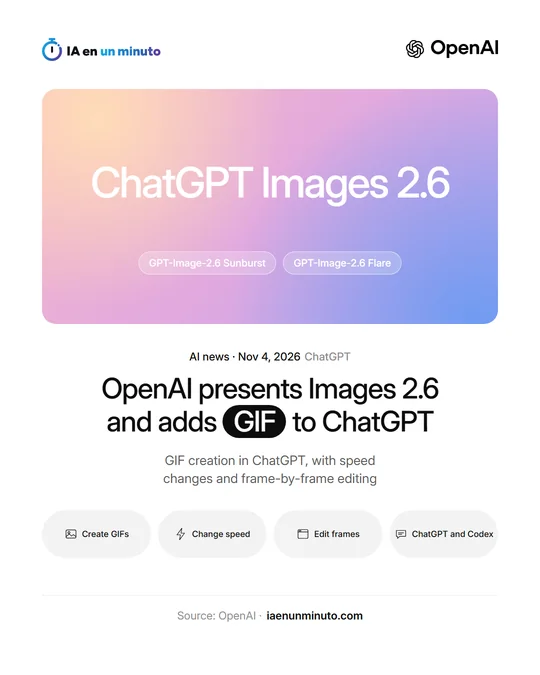
On Wednesday, November 4, OpenAI presented Images 2.6, the new version of its image model for ChatGPT, Codex and the API. With it, ChatGPT turns a written prompt or a photo uploaded to the chat into an animated GIF, and then lets users adjust the speed, touch up single frames and share the result, as The Verge reported and Diario TI picked up. Until now, ChatGPT could not natively make a GIF in a single step.
Among the uses OpenAI suggests are bringing a brand mascot to life for a campaign, making reactions and memes for social media, or turning a hand-drawn sketch into an animated character.
The company says Images 2.6 generates images 50% faster than before. The API offers two models to choose from: GPT-Image-2.6 Flare, built for speed, which with quality set to low can have an image ready in as little as six seconds, and GPT-Image-2.6 Sunburst, for jobs that call for more detail and an image that stays steadier from one edit to the next. Developers also get image markup, already available in ChatGPT, which marks the spot where something should change, SVG export, and a new complexity setting that controls how much planning the model does before it answers.
Images 2.6 is available worldwide in ChatGPT and Codex, on every subscription plan, on desktop, mobile and web. Diario TI notes that it has not yet been specified whether GIFs will have usage limits by plan, or what their maximum length or resolution is. In its system card, OpenAI explains that it keeps the protections of Images 2.5 and adds its own filters for GIFs, which block some content more broadly than in still images.
OpenAI estimates that 4 billion images a week are now created across ChatGPT, Codex and the API, more than half a billion a day on average. In September, the company had put the figure at 3 billion a week, Infobae recalls. The Next Web, cited by both outlets, notes that the split between a fast model and a quality one mirrors that of Images 2.5, presented the same month, and that GIFs arrive months after OpenAI shut down Sora, its AI video app, in March.
Why it matters · analysis and opinion
A simple animation no longer requires editing software or a third-party website: you just ask for it in the same chat where still images are already made. For a marketing team or a small shop, that brings animated mascots, social media reactions or looping product photos within reach without going through a designer. The move also says something about OpenAI's direction: after closing its video app, it offers animation in a light format made for sharing. Before building a campaign around this feature, it is worth checking what has not yet been made clear, such as limits by plan or the maximum length of each GIF. Anyone building with the API will have to decide, task by task, whether Flare's speed or Sunburst's quality pays off more.
Official source: OpenAI · Written with the help of AI: how we make the news
What does it mean for your business? · analysis and opinion
This mainly affects freelancers, shops and small businesses in Spain and Latin America that already use ChatGPT to prepare images for social media, newsletters or their website, and anyone with their own tool connected to the OpenAI API. Anyone who does not use OpenAI image generation does not need to do anything.
In practice, it is worth testing GIF creation with simple pieces, such as a short animation of a product or an opening-hours notice, and reviewing every result before publishing it, since this is a newly launched feature. Photo markup lets users mark directly on the image what they want changed, which can save back-and-forth when requesting edits. For those working with the API, SVG output, the vector image format, is useful for icons or graphics that need to look good at any size, and the Flare model, optimized for faster generation, fits when speed matters most. Our advice is to compare both models with real tasks before changing anything that already works.
The main risk lies in what gets uploaded. The sensible approach is not to animate or edit photos of customers or employees without their permission and, if anyone under 14 appears, to have the consent of their parents or guardians, as required in Spain. Although OpenAI explains that it has added safeguards for GIFs, what gets published remains the responsibility of each company.