A federal judge lets part of the lawsuit against Anthropic over Claude Max advertising proceed
IA en un minuto newsroom · Editor: Jon Elgezabal
In 30 seconds
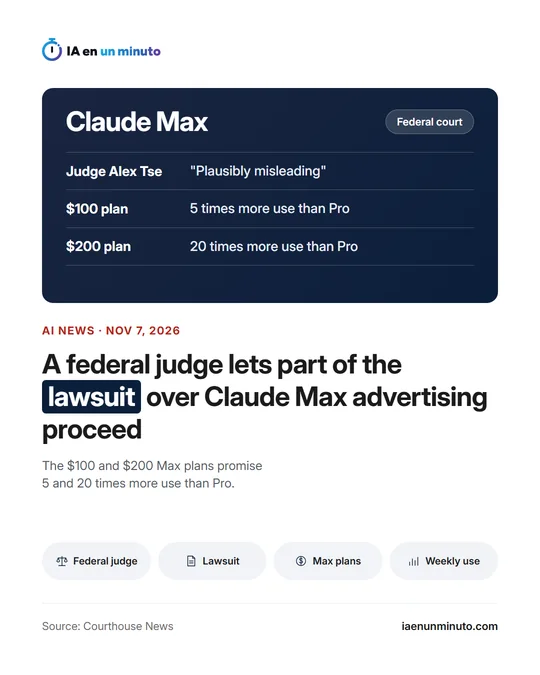
Anthropic will have to keep defending in court the way it sold Claude Max, its $100 and $200 subscriptions. Karl Kahn and Solomon Smith calculate that over a week those plans deliver 3.5 and 6 times what Pro gives, far from the 5 and 20 being advertised. Tse dismissed some of the accusations and has not yet decided whether customers lost out.
A federal judge in San Francisco has cleared part of the proposed class action against Anthropic to go ahead over the way the company advertised Claude Max. These are Claude's two most expensive plans, at $100 and $200 a month, which Anthropic sells with the promise of multiplying the use of the Pro plan by 5 and by 20. Pro costs between $17 and $20 a month.
The ruling, dated Friday, November 6, was signed by Magistrate Judge Alex Tse, as reported by Courthouse News Service and picked up by Infobae. In it, Tse writes that the advertisement is "plausibly misleading." The plaintiffs, Karl Kahn and Solomon Smith, did the math for one of the Claude models: across a full week, the $200 plan gives 6 times the use of Pro and the $100 plan 3.5 times. Those figures are the plaintiffs' own calculations, not a finding by the court.
Everything hinges on how use is measured. According to the judge, in each five-hour session Max subscribers do get five or twenty times more than with Pro, but their weekly cap does not rise by that same factor. Anthropic argued that the extra use was meant per session and pointed to a help page that spells this out. Tse answered that the clarification sat two links away from the main sales pages and that nobody had to go through it to sign up. Since the subscription is charged every month, he added, a customer can fairly take the promise to mean monthly use. The asterisk on one of the sales pages warns that usage limits apply, without mentioning the per-session ones.
Still standing are the claims for negligent misrepresentation and for breach of the subscription contract, as well as Smith's claim under California's consumer protection law. Smith studies computer science and uses Claude for university work, and the judge found that this use is not commercial. Kahn's version of that claim, from someone who relies on Claude Code for programming without saying to what end, was dismissed, although he will be able to add more detail. Tse threw out the claims based on two California laws on unfair competition and false advertising, because both plaintiffs remain subscribed, and rejected the argument that Anthropic breached its duty of good faith by changing usage limits within a billing period.
The case, known as Kahn v. Anthropic, was filed in June 2026 in a federal court in Northern California, according to DiarioBitcoin. It was brought by Monica Vaca and Kati Daffan, former officials at the US Federal Trade Commission. No class has been certified yet, and the court has not ruled on whether subscribers got less than they were promised. Since late October, the Max 5x and Max 20x plans have been called Max and Ultra.
Why it matters · analysis and opinion
The fine print was not enough to close the case, at least at this stage. The judge does not dispute that the multiplier holds per session; what weighs is that customers pay by the month and the clarification sat outside the path to purchase. The reasoning reaches any AI service that combines usage windows with weekly caps: the difference has to be visible where people sign up, not on a separate help page. It remains to be seen whether the class is certified and whether the case goes to trial. Anyone paying for AI subscriptions for a team can get ahead by checking which limit really governs, the session one or the weekly one, before working out how many licences they need.
Source: Infobae · Written with the help of AI: how we make the news
What does it mean for your business? · analysis and opinion
The case is being heard in a court in the United States and does not change what Claude customers in Spain or Latin America receive today. Even so, it serves as a warning to any small business, freelancer, or small team that pays for Claude Pro or Max to work, especially those who program daily with Claude Code (the coding tool included in the paid plans). Anyone who uses the assistant only occasionally is affected very little.
The key point of the lawsuit is that each plan has two different caps: one for each five-hour session and another weekly cap, and the advertised multiplier refers to the first one. Before moving from Pro to a plan costing 100 or 200 dollars a month, it is worth reading the help page about usage limits, not just the sales page, and measuring over a billing cycle how much is used in a normal work week. Our advice is to note which day of the week the quota runs out and decide based on that figure, not on the number in the advertisement.
The practical risk is paying for the expensive plan and running out of margin halfway through the week, right before a deadline. In addition, Anthropic's terms allow it to change the usage limits, so it is prudent not to depend on a single tool for time-sensitive work and to have an alternative ready.