IA en un minutoNewsBusiness and products
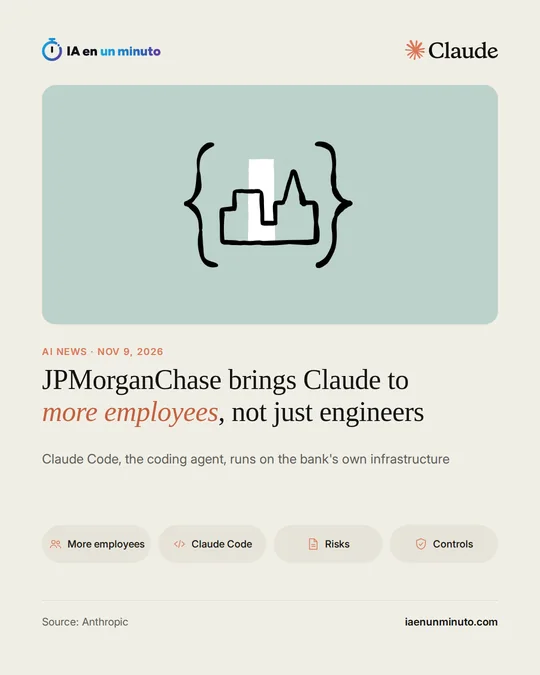
JPMorganChase brings Claude to more employees, not just its engineers
IA en un minuto newsroom · Editor: Jon Elgezabal
In 30 seconds
Anthropic says JPMorganChase is extending Claude beyond its engineers to infrastructure, product, risk and wealth management teams. Claude Code runs in Devspace, inside the bank's infrastructure, with no direct access to credentials or internal systems. Each new model needs the bank's sign-off, access grows gradually and an automated check stops Claude from approving its own changes.
JPMorganChase is taking Claude, Anthropic's AI assistant, to more of the bank's staff, not only its engineers. Anthropic shared the news on its website on Monday, November 9.
According to Anthropic, over the last year Claude's use at the bank had already spread from software engineering into cyber defense and into tools for financial advisors, and it is now reaching more areas. Infrastructure and operations staff rely on Claude Code, Anthropic's coding agent, to watch systems, handle alerts and work out why things fail. Product staff convert requirements straight into task lists for engineering, while other groups apply it to assessing risks and controls and to planning programs. In the corporate and investment bank, Anthropic says work gets to production sooner and the time saved goes to business priorities; engineers are also creating agents of their own, for example to review code changes or fix faults automatically. The security team applies Anthropic's most advanced models to spotting and patching vulnerabilities, work Anthropic had already described as part of Project Glasswing.
In asset and wealth management, the bank sets up small groups that bring business people together with technology and product specialists, and Claude Code is now part of how they write software. In October, J.P. Morgan Asset Management presented a connector that plugs ActiveTax, the 55ip technology, into Claude for Financial Advisors, to weigh the tax effects of changing a client's portfolio.
On controls, Claude Code works inside closed environments such as Devspace, the bank's container-based development platform, which sits on the bank's own infrastructure. The goal is to keep agents from reaching employee credentials or internal systems directly. Access opens up step by step, and each new Claude model has to clear the bank's approval before anyone can use it. Every code change goes through thousands of automated tests and approval checks, one of which gives a strict go or stop, so Claude cannot approve its own work and people remain responsible for each change.
Anthropic does not say how many employees use Claude at the bank or on what timeline access will widen.
Why it matters · analysis and opinion
What stands out is not that a large bank uses a coding assistant, but how it does so. JPMorganChase has surrounded Claude with controls: an isolated environment, permissions that grow little by little, models that do not get in without approval and an automated gate the agent itself cannot open. Much smaller companies can copy the scheme even without a platform like Devspace: keep the agent away from real credentials, decide who validates each change before it reaches production and widen use in phases. That said, the announcement comes from Anthropic and brings no measurable productivity data or usage figures, so it works better as a governance guide than as proof of savings.
Official source: Anthropic · Written with the help of AI: how we make the news