United Airlines Bans Unauthorized AI Agents From Booking Travel on Its Website and App
IA en un minuto newsroom · Editor: Jon Elgezabal
In 30 seconds
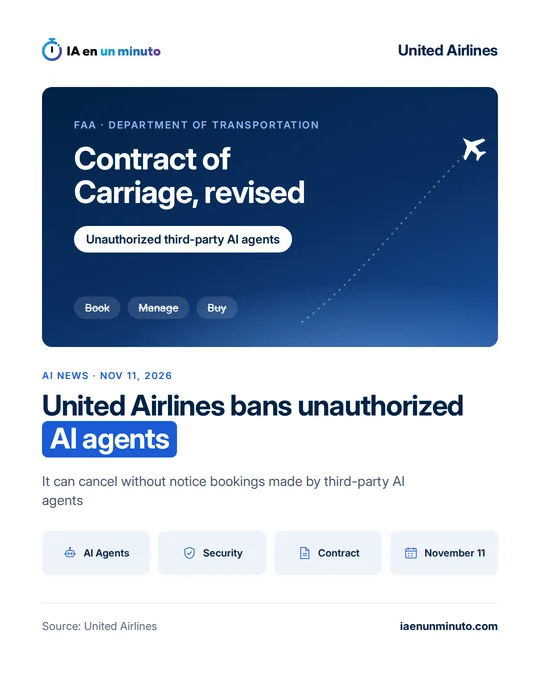
United Airlines is shutting its channels to outside AI assistants that try to buy, change or manage tickets without its permission, both on united.com and its app and through agencies. The company points to risks for its customers' data and possible clashes with FAA rules, and it may void without warning whatever those agents book. AI can still help prepare a trip as long as it stays away from its systems.
On Wednesday, United Airlines said it will no longer let third-party personal AI assistants or agents that it has not authorized book, manage or pay for trips through its channels. That covers its website and app and, indirectly, travel agencies and aggregators. To do so, it has changed its rules on booking, ticketing and distribution.
The airline frames the move around protecting its customers' data and accounts. It explains that handing account login details to an AI assistant can expose sensitive information, and that whatever the tool does may end in purchases the customer never wanted, changes to the account or MileagePlus miles being spent. It adds that these automated actions could clash with the rules of the FAA (the Federal Aviation Administration) and the U.S. Department of Transportation. Its example is check-in, where a person has to confirm that their luggage carries no banned substances, such as explosives. United notes that companies in banking and retail have taken similar steps, and Reuters describes it as the latest move against agents that are increasingly able to plan and book trips.
According to a review by Unite.AI, the Contract of Carriage, dated as revised on November 11, treats as an AI agent any program that acts autonomously or semi-autonomously, even when a person watches over or approves what it does. It also adds bookings made, changed or managed by these agents to those United may void without warning. When a breach occurs, the carrier further reserves the right to invalidate tickets, strip miles, withdraw elite status, cancel program membership or go to court. The website's terms of use require prior written permission for an automated agent to enter united.com or the app, and they exempt, among others, accessibility tools for people with disabilities. Bookings made before November 11 will not be voided.
Using AI to research and plan is still allowed as long as the tool does not enter united.com or the United app, and the airline asks customers not to give it passwords, confirmation numbers or MileagePlus details. Its guidance for customers, as reported by Unite.AI, says United does not yet work with any third-party AI agent, and that it wants standard, secure integrations in place before opening accounts and bookings to them. It will also update its Digital Trust Center to explain what the change means, how to protect an account and where to turn if an agent does something it was not asked to do.
Aviation analyst Henry Harteveldt, of Atmosphere Research Group, told CBS News that he sees the move as a way for United to keep control of its sales. In his view, the airline does not want one more middleman, "potentially even more powerful", on top of the search engines, price comparison sites and online agencies it already deals with, and it wants to save what the waves of bot-driven flight searches cost it. Harteveldt adds that United tickets can still be booked on Kayak, Hopper, Google Flights and other aggregators. CBS points out that other carriers are taking another path: Southwest lets ChatGPT users look up its flights and reach its website from within that app.
Why it matters · analysis and opinion
A customer authorizing an AI assistant does not oblige the airline to let it in: that is the core idea behind the move, and it clashes with the promise of agents that buy and manage things on their own on any website. United is not closing the door on automation, but making it depend on integrations the airline itself controls. If other airlines, hotels or stores follow the same path, the people building these assistants will have to negotiate access company by company instead of browsing websites the way a person would. For travelers, the change calls for immediate caution: review recent bookings made with an agent and change the password if it was shared, as United itself recommends.
Official source: United Airlines · Written with the help of AI: how we make the news
What does it mean for your business? · analysis and opinion
This mainly affects small travel agencies in Spain and Latin America that sell United flights, and companies whose staff organize their trips using assistants or browsers with agent features. Under the revised conditions, neither travel agencies nor booking platforms can use third-party AI agents to search for, book, or manage United travel, and their own AI tools need the airline's authorization. Anyone who only uses AI to compare options using general information, without entering united.com or the app, does not need to change anything.
Our advice is to review which tools currently access the company accounts at United and remove any automation that books, changes tickets, or buys seats or ancillary products. If anyone has given an assistant their MileagePlus username, it is wise to change the password as soon as possible and check that recent bookings and ticket issuance are in order. The prudent approach is for a person to finish any AI-suggested searches directly on the website or the app.
The risk is not minor: besides canceling bookings without notice, United reserves the right to invalidate tickets, cancel the remaining segments of the itinerary, remove miles, revoke elite status, or cancel program membership. Bookings made before November 11, 2026, will not be canceled.