IA en un minutoNewsBusiness and products
CD Projekt Red uses AI, with the actor's permission, to adjust Geralt's Polish voice in the new The Witcher 3 expansion
IA en un minuto newsroom · Editor: Jon Elgezabal
In 30 seconds
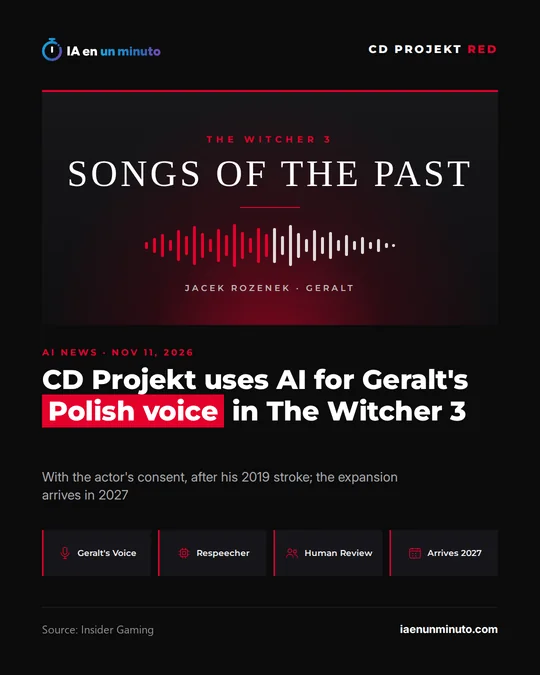
Jacek Rozenek, who voices Geralt in Polish, is still recording for Songs of the Past, but CD Projekt Red touches up his voice with Respeecher so it resembles how he sounded before his 2019 stroke. Each line is checked by a person, and Doug Cockle's English dub stays untouched. The expansion arrives in 2027, and the actor has given his permission.
CD Projekt Red is using artificial intelligence to adjust the voice of Jacek Rozenek, the actor who plays Geralt in the Polish version of The Witcher 3, in the new dialogue for Songs of the Past, the game's upcoming expansion. Rozenek records every line himself; the studio then runs each recording through Respeecher, an AI voice tool, so that it sounds like the sessions he did before the stroke he had in 2019. The goal is that, for Polish players, what was recorded years ago and the new material do not clash.
The English dub, in which Geralt is played by Doug Cockle, is left out of this process.
The details come from an interview Stephen Totilo conducted for Game File with people from CD Projekt Red, picked up on November 11 by Insider Gaming. According to the studio, every piece of dialogue goes through human review. Mikołaj Szwed, localization producer at CD Projekt, acknowledges that AI is a major worry among voice actors, but argues that this is a case where it can be used "ethically, with consent." Rozenek, for his part, says the aim is to get as near as he can to "my voice from 12 years ago" and that he trusts the game's team.
The studio recently released a remastered edition of The Witcher 3, which set a new all-time high for the game's players on Steam. Songs of the Past arrives in 2027.
Why it matters · analysis and opinion
When people talk about AI in dubbing, the debate is usually about voices cloned without permission or actors being replaced. Here the opposite happens: the performer keeps recording, has agreed to the process, and the tool only makes up for the passing of time and the effects of an illness. That does not settle the debate, but it gives the industry a concrete example of acceptable use, with explicit consent, the actor inside the process and a person checking every line. That the studio limits it to the Polish version and leaves the English one as it was points to a cautious, case-by-case approach. What has not come out are the terms of the deal, such as whether the actor is paid separately for the adjusted voice or who will decide about it in the future.
Source: Insider Gaming · Written with the help of AI: how we make the news