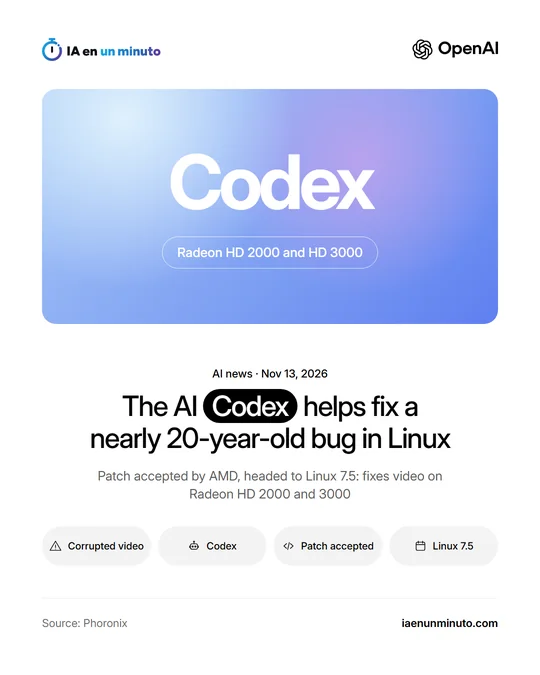
Codex, OpenAI's AI assistant, helps fix a nearly 20-year-old bug in a Linux graphics driver
IA en un minuto newsroom · Editor: Jon Elgezabal
In 30 seconds
Ted Bullock found on his iMac7,1 why video got corrupted on Radeon HD 2000 and 3000 cards under Linux, and fixed it with help from Codex. The decoder failed when reading from system memory during GPU rendering, so the patch keeps that data in VRAM. AMD has put it in its November 12 batch for Linux 7.5, though owners of the other chips in the family still need to confirm it.
Radeon HD 2000 and HD 3000 graphics cards, close to two decades old, finally have a Linux patch for a video bug that Phoronix puts at nearly 20 years of age. Its author, Ted Bullock, a newcomer to the driver, says he leaned on Codex, OpenAI's AI assistant, to get there.
Bullock spotted the corruption on his old iMac7,1, which carries an RV610 GPU. Frames got damaged whenever the UVD video decoder pulled compressed video out of system memory while the GPU was busy rendering. Once the input data sat in VRAM, the card's own memory, playback came out clean, and switching off graphics rendering made the problem go away as well.
The patch makes the driver keep the UVD buffers in VRAM for this chip family, something it was already doing for other models. It applies to the RV610, RV620, RV630, RV635 and RV670, which use the same decoding path and the legacy R600 firmware. Bullock has only tested it on his own machine, running Debian, and notes that someone who owns the other chips would have to confirm it works for them too. In his words, he used Codex "to help with the investigation, testing and patch."
AMD, which Phoronix says has not officially maintained R600 support for many years, accepted the fix and included it in the batch of graphics driver patches it sent out on November 12. That batch is headed for the Linux 7.5 merge window, which opens at the end of the year. As SoftZone explains, machines will not get the fix until the stable Linux 7.5 release is out and each distribution adopts it.
Why it matters · analysis and opinion
The case shows where a coding assistant fits today: in the hands of someone who has the faulty machine in front of them, can reproduce the bug and check every change. Codex helped with the research, the tests and the code, but the testing on real hardware was done by Bullock, and the patch had to be accepted before it went into AMD's batch. It also points to the value of these tools in legacy code that no vendor looks after anymore: understanding an old driver gets cheaper, and that makes it more realistic to keep hardware going after its maker has left it behind. What remains is something no AI settles alone: owners of the other chips in the family need to confirm the fix works for them too, and the stable release has to reach the distributions.
Source: Phoronix · Written with the help of AI: how we make the news