ElevenLabs unveils ElevenAI, an experimental app for taking meeting notes and dictating, in preview
IA en un minuto newsroom · Editor: Jon Elgezabal
In 30 seconds
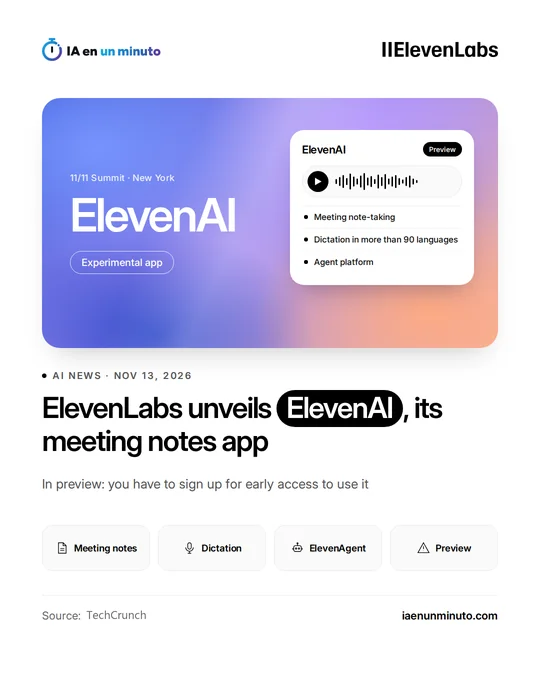
ElevenLabs has launched ElevenAI at its 11/11 Summit in New York: an app that takes meeting notes, dictates text and connects with agents. ElevenAI is still in preview, so trying it means requesting early access. TechCrunch presents it as a bet for teams that competes with Fireflies, Granola and Wispr Flow, with dictation in more than 90 languages.
ElevenLabs, the AI voice company, is joining the tools that take notes in meetings. It has unveiled ElevenAI, an experimental app that brings meeting notes, dictation and a link to AI agents together in one place.
The company showed it this week during its 11/11 Summit event, held in New York. It is still in preview: downloading it is not enough, and people have to join an early access list.
ElevenAI takes notes in meetings and lets the other participants know they are being recorded. It also lets people ask questions about what was discussed in earlier meetings, and offers live help during a conversation to bring back a detail mentioned in another one. Companies can connect it to ElevenAgent, the ElevenLabs agent platform, so it handles later tasks such as preparing a draft email from the notes. Dictation turns speech into tidy text in any application and in more than 90 languages, and the company says the app understands the terms specific to each industry.
In recent months, Granola, Wispr Flow and Fireflies have all brought out similar features. According to TechCrunch, ElevenLabs, valued at 22 billion dollars, is framing it more as a product for teams than as a tool for one person, and as a way for companies to avoid paying for licences to another notes service. Over the past week, the company has also released the v3 series of Scribe, its speech-to-text models, with live transcription. TechCrunch gives no price and no date for general availability.
Why it matters · analysis and opinion
Automatic meeting notes have become a hotly contested field, and the arrival of a company that specialises in voice changes the kind of rival: ElevenLabs depends on no one for speech recognition, because that is its own business. Its move is less about winning individual users than about getting into companies through their teams, linking what is said in a meeting with agents that act afterwards. If it works, the value will lie less in the transcript, which almost anyone offers now, and more in turning conversations into finished tasks. Before trusting it with client meetings, the basics are missing: how much it will cost, when it will open to everyone and how it handles the recordings of the people taking part.
Source: TechCrunch · Written with the help of AI: how we make the news
What does it mean for your business? · analysis and opinion
The people most interested in this are small teams, consultancies, and freelancers in Spain and Latin America who spend a good part of the week in meetings and already use, or are considering using, a tool that takes notes. For now this is not something you install and simply use: it is an experimental app, it is in preview, and the only way to access it is by signing up for early access. The news also does not give prices. Anyone happy with their current notes system has no reason to switch yet.
If this interests you, the sensible approach is to sign up and try it first in low-stakes internal meetings, before using it with clients. It is worth checking three things: whether it understands your industry vocabulary well, something ElevenLabs claims it does; whether searches about past meetings return what was actually said; and whether the email drafts prepared through the ElevenAgent connection need a lot of editing. Those drafts should always be reviewed before sending.
The main risk lies in recording other people. Although the app notifies participants that the conversation is being recorded, our advice is to ask for verbal permission at the start and explain what the transcript will be used for, especially in meetings with clients, suppliers, or candidates. It is also not advisable to bring conversations with confidential information into an experimental tool until you know exactly where the data is stored and under what conditions.