IA en un minutoNewsBusiness and products
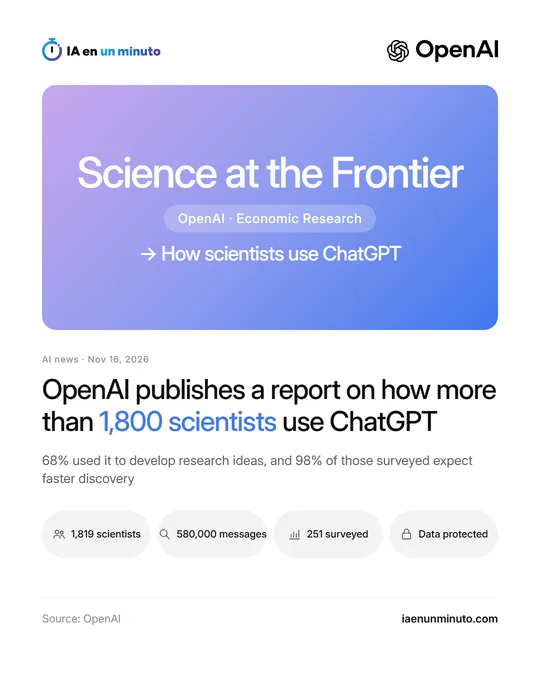
OpenAI publishes a report on how more than 1,800 scientists use ChatGPT in their research
IA en un minuto newsroom · Editor: Jon Elgezabal
In 30 seconds
OpenAI has looked at how 1,819 scientists from its pilot for researchers work with ChatGPT and written it up in a study of its own. ChatGPT helped 68% shape research ideas, and the 251 people surveyed believe they would have needed nearly twice as long without that help. OpenAI cautions that these are impressions from participants and that nobody has yet shown science moving faster.
OpenAI has released Science at the Frontier, a report by its economic research team on what scientists do with ChatGPT. The study draws on 580,186 scientific messages sent between August 20 and September 22, 2026 by 1,819 participants in the summer pilot of ChatGPT for Academic Researchers, the ChatGPT program for academic researchers, and on a later survey answered by 251 of them.
According to the report, ChatGPT shows up throughout the research process, from literature review to the analysis of evidence. In all, 68% of the scientists turned to it to develop research ideas. Within the messages about ideas, 35% of the time the scientist arrived with a specific question, 36% of the time they came with an idea and asked to have it refined, and 23% of the time they wanted ChatGPT to propose a research question.
Those surveyed estimated that the same work, at equal quality, would have lasted 1.9 times as long as it did with AI, that is, nearly twice as long. This is an estimate by the participants themselves, not a measurement. Of the 250 people who answered the question about timelines, 98% think AI will bring discoveries sooner in their own field. Asked to explain why, the most repeated reason was getting research done more quickly (52% of the reasons collected), followed by finding more promising questions (23%) and tackling a broader range of questions (14%).
OpenAI acknowledges the limits of the study: checking whether those expectations turn into faster discoveries will require further research, and progress also hinges on staff, funding and the experimental capacity that scientists have for testing their ideas.
On privacy, the company explains that automated classifiers sorted the messages by kind of activity, such as writing code, analyzing data or reviewing literature, and that the team saw only those categories and never read the messages or ChatGPT's replies. By default, OpenAI does not train its models on data from the program's participants.
The report arrives together with the expansion of the program, through which OpenAI intends to reach 200,000 researchers with free access, according to that announcement.
Why it matters · analysis and opinion
The most quoted figure will be the time saved, and it is the most fragile: it comes from what the participants themselves believe, not from a stopwatch, and people who volunteer for an AI program tend to arrive convinced. What the study does show is what the tool is really used for: less to think on its own and more to polish ideas the researcher already brings, with later checks on what it answers. That pattern is useful outside the lab, because it describes sensible use in any trade that relies on judgment: ask, cross-check and make the decision oneself. It is also worth remembering who signs it: the company that sells the product, which publishes the report on the same day it expands the program. What is missing is someone independent measuring results, not impressions.
Official source: OpenAI · Written with the help of AI: how we make the news