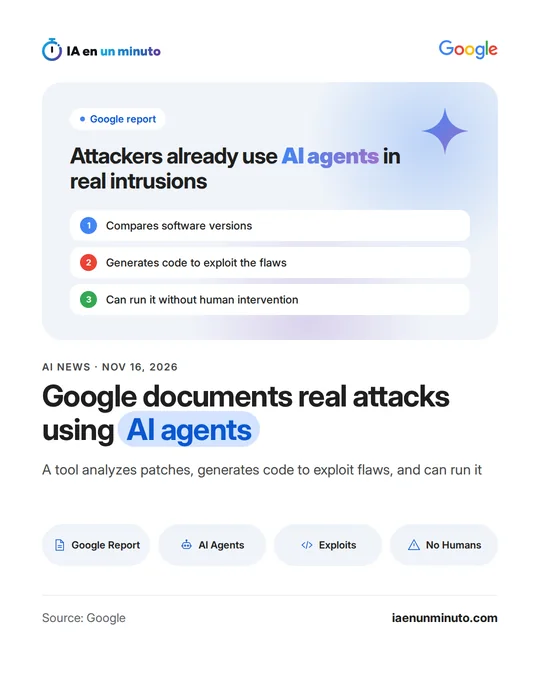
Google report documents that attackers already use AI agents in real intrusions
IA en un minuto newsroom · Editor: Jon Elgezabal
In 30 seconds
Google reports that AI agents have moved from the lab into genuine intrusions, with tools such as CAIRN turned on the United States aerospace sector. GTIG also found a program that reviews each published patch, works out the flaw it fixes and launches the attack with no one stepping in. Google concedes these systems are still noisy and easy to spot, though it expects that to change.
AI agents are now taking part in real cyberattacks, not just in tests. That is the claim of the latest quarterly report from the Google Threat Intelligence Group (GTIG), Google's threat intelligence team, written with Mandiant: several attacker groups are using open-source tools designed for penetration testing, made up of multiple cooperating agents, to automate specific phases and tasks of intrusions in progress.
Beyond ARTEX, which had already been reported, the report names CAIRN, CyberStrikeAI and PentAGI. GTIG says it saw CAIRN in intrusions against targets that include the United States aerospace sector, and a platform built on PentAGI that one actor used, from late August to early October 2026, to scan organizations in Asia for vulnerabilities. Those experimenting with these tools include financially motivated groups and suspected espionage groups linked to China.
What the report presents as new is something else: for the first time, GTIG has identified attackers who fully automate finding and exploiting flaws, with nobody supervising. On an exposed attacker server it found a tool, dubbed exploit_agent, that compares the code of popular web applications before and after a patch is announced, studies the differences to locate possible vulnerabilities, writes the code to exploit them and runs it automatically. Data on the server suggests its operator was interested in French media, entertainment and education websites.
Google warns that this shortens the time organizations have to install a patch before someone takes advantage of it. It also notes limits: the mechanics of the intrusions are the usual ones, such as compromised credentials and unpatched systems, and these tools trade stealth for speed, because their activity leaves recognizable traffic and traces that make them easier to detect. The company expects them to become stealthier and to need less human involvement as the models improve.
Why it matters · analysis and opinion
Publishing a patch has always meant publishing a clue too: whoever compares the new version with the old one sees what was fixed. What is new is that this job, which used to demand a skilled person, is now done by a machine working alone and without rest, so the time between the advisory and the attack shrinks. For a small company the consequence is direct: leaving updates for a quiet moment is no longer prudent, above all for anything facing the internet, such as the website, the online store or remote access. Turning on automatic updates wherever possible, knowing which programs are installed and watching logins with credentials remain the defenses that work. The report itself offers a reason not to panic: these tools are noisy and can be detected.
Official source: Google Cloud · Written with the help of AI: how we make the news
What does it mean for your business? · analysis and opinion
This does not stay limited to large companies or the aerospace sector. Any small business or freelancer in Spain or Latin America with equipment, servers, or software connected to the internet is exposed, because what Google describes is a faster way to exploit flaws that are already known. Whoever keeps everything updated runs less risk; whoever puts off updates is exactly the target, since the patch itself gives attackers clues for attacking those who have not installed it yet.
Our advice is to turn on automatic updates on computers, phones, and routers, and to set aside one day a week to check the updates for software that does not update itself, especially software exposed to the internet. The source cites attacks against PaperCut servers, a print management program, so anyone using it should check they have the latest version. It is also wise to change reused passwords, turn on two-step verification, and make a simple list of which services the business has open to the outside.
The cost of these measures is close to zero, apart from some time. The risk of not doing it grows, because according to the report these attacks chain together at machine speed and reduce the time available to react. The positive point is that current agents still leave detectable traces, so checking antivirus or firewall alerts is still useful.