Cursor confirms an attacker slipped manipulated copies of the Claude Code extension into its marketplace
IA en un minuto newsroom · Editor: Jon Elgezabal
In 30 seconds
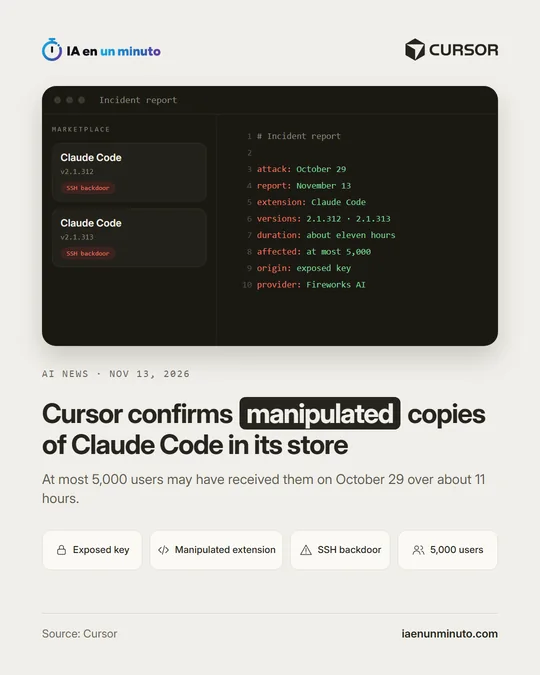
Cursor has explained how manipulated copies of Claude Code reached its extension store: an attacker used a key that Fireworks AI left exposed to copy coding-agent traces and, with a credential found in them, uploaded the copies on October 29. They stayed up for about eleven hours, and no more than 5,000 users could have received them. The company considers the incident contained: the attacker's last activity, on November 1, was blocked.
An access key that a provider left exposed lies behind the manipulated copies of the Claude Code extension that were served through the marketplace of Cursor, the AI-assisted code editor. The company lays this out in an update to its incident report, published on Friday, November 13, after two weeks of investigation. Its first notice dates from late October.
According to Cursor, on October 29 an attacker planted unauthorized, harmful builds of Anthropic's extension, versions 2.1.312 and 2.1.313, in the cache behind Cursor's extension catalog. Anthropic did not publish them and, the company says, there was no flaw in Anthropic's product. Open VSX, the repository the marketplace relies on, never held the malware. The copies were up for approximately eleven hours, and at most 5,000 users who asked for particular versions of the extension that day may have received the malicious one.
The first notice already explained that the code tried to install an SSH backdoor, meaning a permanent remote way into the machine: it added a key belonging to the attacker, tried to switch on the SSH service and attempted to open a reverse tunnel. Cursor said at the time that, except in very unusual cases, that last step would fail because of errors in the malicious code and a lack of administrator rights, although the key, the persistence and the sending of machine details did go ahead. BleepingComputer, which credits the analysis of those errors to the firm Phorion, reported that they likely blocked remote access on many Windows and macOS machines where SSH was not already running.
The report places the start of the attack at Fireworks AI, the outside provider Cursor used to train and run models. The attacker got hold of an access key that Cursor had issued to that company and that Fireworks exposed, and with it copied data from a read-only store the two shared. It held a limited set of coding-agent traces, mostly from 2025, taken from sessions without Privacy Mode, which Cursor was allowed to use for model training. A few included unredacted credentials: Cursor says API credentials were exposed for fewer than 0.01% of its customers, and the traces of fewer than 0.05% of users were within the attacker's reach.
With those credentials, the attacker reached several of Cursor's SaaS tools. It accessed archived source-code repositories that were not production ones (some with business contact details), limited customer-support data and emails, usage metrics and contact details, summaries of some agent conversations, and credentials that users had sent to the support team. A credential stolen from that data let the attacker place the copies in the marketplace cache on October 29.
Cursor considers the incident contained: the last attacker activity it saw was on November 1, and it blocked it. It says the code and prompts of Privacy Mode users, its production systems, the Cursor app and its updates (which ship from a separate code-hosting system the attacker never reached), the rest of the marketplace's extensions and customers' code repositories were not affected. It has moved all inference traffic off Fireworks, deactivated the key, rotated internal credentials and rebuilt the marketplace, and says it has contacted each affected customer directly.
Cursor asks anyone who installed or updated to version 2.1.312 or 2.1.313 from that marketplace during the exposure window to follow the steps in its security notice, which include scripts to check the machine, since uninstalling the extension may not be enough.
Why it matters · analysis and opinion
The episode shows that the weak link can sit outside the house: the breach began at a provider, ran through shared data and ended up in the extension store that developers use. For anyone coding with AI assistants the lesson is twofold. First, extensions are also code, and here the harmful code traveled inside an extension that carried the name of a well-known company. Second, records of sessions with an agent can hold keys without anyone knowing. That is why it makes sense to check whether a machine holds traces of the affected versions, rotate the credentials it could reach and review what data is shared with third parties to train models.
Official source: Cursor · Written with the help of AI: how we make the news
What does it mean for your business? · analysis and opinion
This affects small businesses, freelancers and small studios that code with Cursor and have the Claude Code extension on macOS or Windows, especially if they installed or updated it on October 29, while the manipulated copies were available. Anyone who does not use Cursor, or who installs Claude Code outside its marketplace, is not part of this incident, because the original Anthropic extension was not compromised.
The sensible step is to look at the Claude Code version on each machine and, if it is 2.1.312 or 2.1.313 and was installed in that window, look among its authorized SSH keys for one labeled svc-telemetry. If it appears, Cursor treats the machine as affected: it has to be isolated, the key, the persistence scripts and the tunnels removed, and the API keys and passwords handled from it changed. Anyone who administers a team on Cursor should also check their email: the company says it sent administrators the list of keys to rotate.
As our own judgment, it is wise not to paste credentials into conversations with a coding agent or send them to a tool's support team: here, a few traces with unredacted keys gave access to other systems. Cursor says Privacy Mode kept the code and messages of those who used it out of the incident. These checks cost no money, only a little time from the technical team.