Apple launches a study with its own app in the US to analyze how people use AI for health
IA en un minuto newsroom · Editor: Jon Elgezabal
In 30 seconds
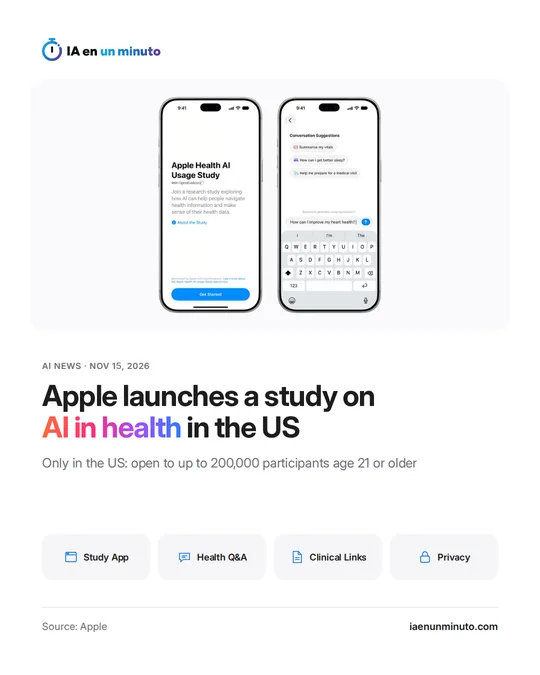
Apple has opened a study in the United States, with its own app, to observe how people turn to AI when looking up health questions, together with OpenEvidence. Participants ask questions and get answers with clinical citations, and can contribute iPhone data such as sleep or activity. The cap is 200,000 adults from age 21 with an iPhone 15 Pro or later; Apple says the data collected will stay out of model training.
Apple wants to find out how far people trust AI when they ask it about their health. On Sunday, November 15, it announced the Apple Health AI Usage Study in its newsroom: a virtual research study with its own app, for now only in the United States. It is run together with OpenEvidence, a clinical AI platform used by healthcare professionals, and aims to measure trust, the quality of the answers, comprehension and what participants go on to do in their daily lives.
In the app, participants will be able to ask everyday health questions and get explanations in plain language, with links to the peer-reviewed clinical citations behind each answer. If they wish, they can also share types of HealthKit data, the iPhone's health system, including resting heart rate, activity, sleep patterns or laboratory results, in order to test whether answers improve when the AI knows that data. The study will also explore whether these tools help people prepare for visits to their doctor. ABC News offers an illustration: a person who asks how to get a better resting heart rate might receive guidance drawn from their own readings instead of generic tips.
Up to 200,000 people age 21 or older across the United States can take part, provided they have an iPhone that supports Apple Intelligence (the iPhone 15 Pro or later) and iOS 26 or later. Participants download the study app and, according to ABC News, go through an informed consent process.
Apple says nothing collected in the study will go into training AI models and that each participant decides whether to share HealthKit metrics or survey responses. According to ABC News, citing Apple, questions pass through protections that strip out identifying information before they reach OpenEvidence, which will erase the questions and answers within 24 hours and will not train its model on them either. The app includes safeguards meant to detect certain worrying questions and suggest consulting a professional, and Apple specifies that it cannot be used to diagnose or treat any condition, nor to replace medical advice.
The study arrives at a time when chatbots are already a common way to look up health information. ABC News cites a February 2026 University of Oxford study, published in Nature Medicine, according to which chatbots correctly identify nearly 95% of conditions in clinical cases, but ordinary people land on the correct answer in under 35% of cases when they try to make sense of dense guidance. Apple told ABC News that its goal is not only to inform its future products but also to make the research widely available. Neither Apple's announcement nor ABC News says when results will be published or whether the study will reach beyond the US.
Why it matters · analysis and opinion
Apple is not launching a health assistant here but a study, and the difference matters: before offering an AI that answers medical questions for many people, it wants to measure whether users understand what they read and act sensibly. That the engine is OpenEvidence, built for professionals, and that Apple supplies the plain language and the experience points to a split of roles: clinical credibility comes from a specialist partner and user trust from the platform. What remains unclear is what will be done with the results: with no publication date, it is not clear whether what is learned will reach real products or people without a recent iPhone. For anyone developing health or wellness services, the message is that an AI that talks to patients will be judged by its clarity and by whether the source of each answer can be checked, not only by being right.
Official source: Apple · Written with the help of AI: how we make the news