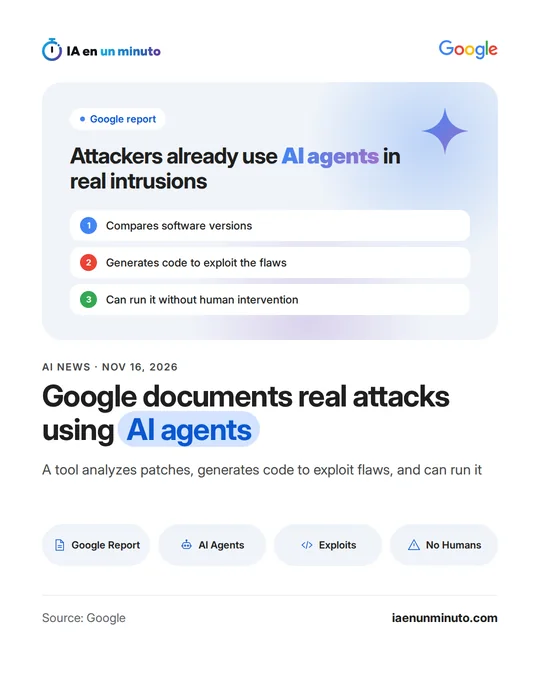
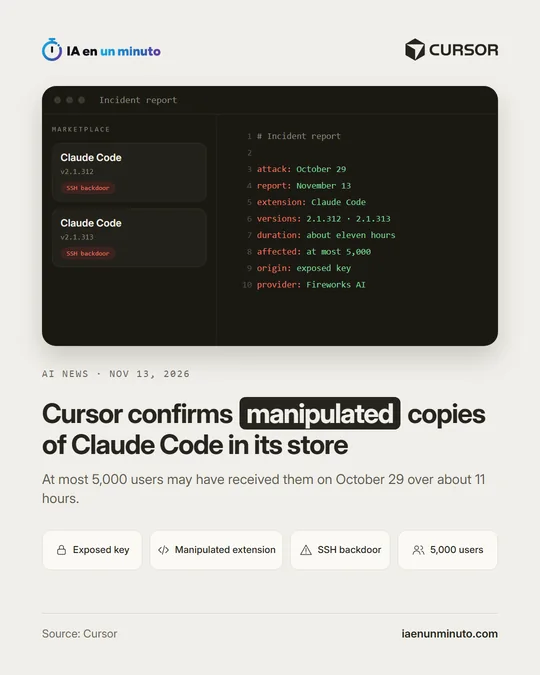
Amazon detects logs of AI agents that tried to steal AI keys
IA en un minuto newsroom · Editor: Jon Elgezabal
In 30 seconds
Amazon's decoy sensors, which pose as AI services, received requests from automated agents carrying the history of their own operations. Between October and November they showed one plan to steal access keys to AI models and another to get past the identity checks of two cryptocurrency exchanges with fake video. Amazon did not witness the attacks and cannot check what the agents noted as achieved.
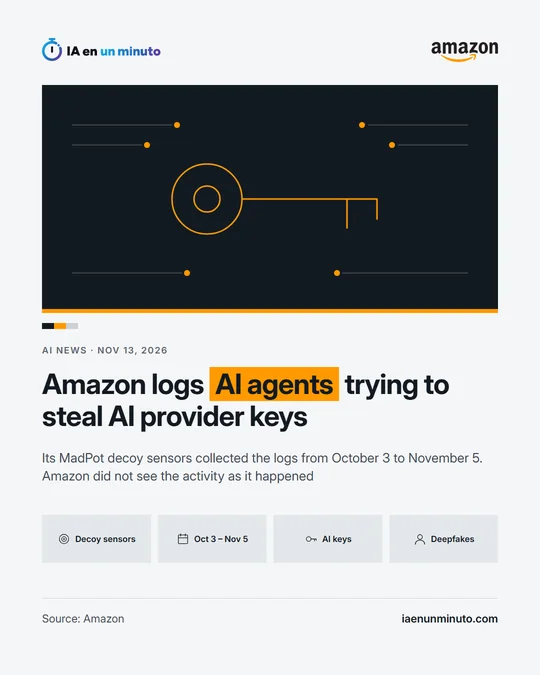
Amazon has reported that its decoy sensors logged AI agents trying to get hold of access keys to AI models. It explains this in a post on its AWS security blog dated Friday, November 13.
The records came from MadPot, Amazon's worldwide network of decoy sensors. Between October 3 and November 5, some of those sensors, set up to look like common language-model interfaces, received requests from agents that treated them as a real AI service. Each request often carried the full history of the campaign. Amazon did not witness that activity as it happened and cannot check the results the agents noted down; what the records do show is what their operators were after.
The most prominent campaign was the theft of access keys to AI models. The agents looked for internet-exposed applications that store keys from several providers, such as the LiteLLM and One API model gateways or the Dify, Langflow and Open WebUI app-building tools, tested whether the keys worked and kept them in a shared pool. The stolen keys were fed into the framework's own model gateway and paid for the models that powered the agents still looking for more. According to Amazon, the most likely aim was to use those models while someone else paid. The instructions called for treating keys exposed in public for more than 30 days as low-value material.
Amazon assesses with moderate confidence that the agents used ARTEX, an open-source framework for AI penetration testing, because of references to the tool in the instructions and in other technical traces. With the same moderate confidence, it attributes the activity to separate groups with links to China, based on the simplified Chinese in the instructions, the configured time zones, the chosen targets and the tools those groups usually use.
A second campaign tried to get past the identity verification (KYC) of two cryptocurrency exchanges with real-time fake video and forged ID document photos. According to Amazon, the verification provider's server rejected the deepfake in every recorded attempt.
Amazon says it notified AWS customers who might have been affected, as appropriate. Because it could not confirm activity against other organizations, it published indicators of compromise so that anyone running the technologies named can check their own environments. Its conclusion is that none of the techniques was new: what AI agents change is the attacker's speed and persistence, which succeeded where basic hygiene was missing, such as default credentials, keys left in code or unpatched software.
Why it matters · analysis and opinion
What is useful in this report is not the attack but that Amazon saw it from the inside, through the agents' own records. The practical lesson is that model gateways and AI tools a company sets up for itself are now a target, as a badly configured mail server once was. If an admin panel is open to the internet, keeps its factory password or stores provider keys in plain view, someone will find it soon, and the bill for that use will land on whoever set it up. It is worth reviewing which AI tools have been deployed, who can get in, which keys they hold and whether there are alerts for unusual spending. What remains unknown is how much of what the agents claimed to have achieved is true: Amazon cannot verify it.
Official source: Amazon · Written with the help of AI: how we make the news