US limits remote access to advanced AI chips with an interim rule
IA en un minuto newsroom · Editor: Jon Elgezabal
In 30 seconds
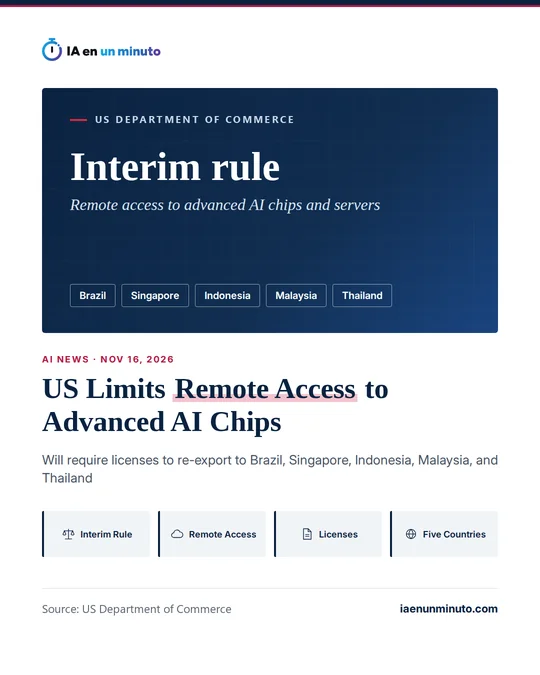
The US Department of Commerce is clamping down on long-distance use of top-tier AI chips through an interim rule. Singapore, Brazil, Thailand, Malaysia and Indonesia fall under a new license requirement for receiving those semiconductors. Commerce wants to keep anyone from dodging current bans by renting compute at sites in other countries.
The US Department of Commerce published an interim rule this Monday, November 16, meant to limit remote access to the most advanced artificial intelligence (AI) chips and servers. It was issued by the department's Bureau of Industry and Security (BIS), which says in its press release that the text was drafted at the direction of the Treasury Department and the National Security Council. BIS refers to this hardware as "super intelligence" chips.
The stated goal is to close an indirect route: getting around the restrictions that already weigh on sensitive US technology by contracting computing capacity in data centers located in third countries. The release argues that progress in the cloud and in this infrastructure makes it ever easier to use that capacity from a distance, including from facilities that sit outside the countries under export restrictions. The rule, it adds, brings the safeguards for remote access closer to the controls that already govern how this equipment is physically shipped.
In practice, CBS News reports, the license requirements already in force gain a new one: a license will be needed to export, re-export or transfer advanced semiconductors to Thailand, Singapore, Malaysia, Indonesia and Brazil. Bloomberg, in a report carried by Yahoo Finanzas, places the measure after heightened scrutiny of semiconductor exports.
The official release gives no application dates and does not say which chips are covered; it points to the full text of the rule, available on the BIS website.
Why it matters · analysis and opinion
Until now, export controls looked mostly at where a chip physically travelled. This rule also looks at who uses it from a distance, even if the hardware never leaves the data center where it is installed. The first to be bound are those who send advanced semiconductors to the five countries named, who will need a license, and, as a knock-on effect, the data centers in those countries that depend on that supply. Anyone buying cloud computing capacity outside the US would do well to ask their provider where its machines are and whether the change reaches it. Because this is an interim rule, the text may change, and the release does not specify dates or which chips are covered.
Official source: Bureau of Industry and Security (BIS) · Written with the help of AI: how we make the news