Von der Leyen Says Europe Needs to Invest at Least 500 Billion Euros in Its Technological Sovereignty
IA en un minuto newsroom · Editor: Jon Elgezabal
In 30 seconds
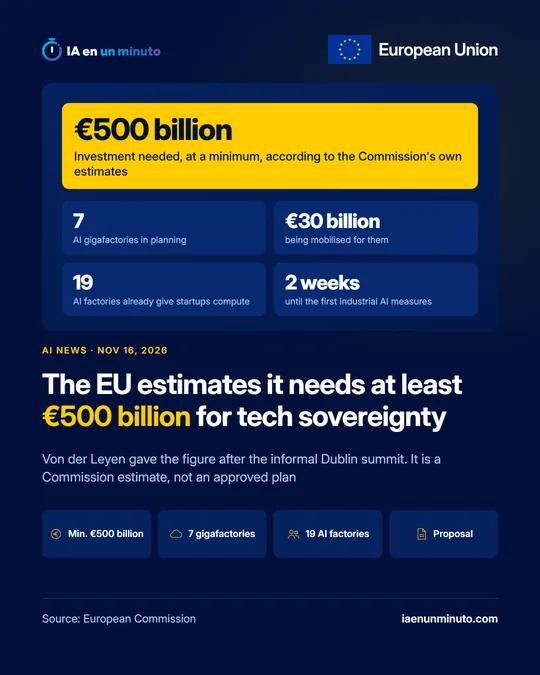
Ursula von der Leyen has put a price on Europe standing on its own in technology: a minimum of 500 billion euros, worked out by the European Commission itself and not yet approved. Europe is also preparing seven AI gigafactories, with about 30 billion euros mobilised, on top of the 19 AI factories already running. Jim Snabe serves as special envoy for industrial AI, and the first measures from that work are expected in two weeks.
Europe has to invest at least 500 billion euros to secure its technological sovereignty. That was the figure European Commission President Ursula von der Leyen put forward on Friday, November 13, at the close of the informal European Council in Dublin, which dealt with artificial intelligence and Ukraine, and she framed it as the Commission's own calculation: "according to our own estimates". It is an estimate of what is needed, not approved spending or a fund holding that money. The Commission's Representation in Germany published its summary of her remarks on November 16.
Von der Leyen pointed to where the gap lies. Europe produces more tech startups than the United States, she said, yet many cannot find the backing they need to grow, which is why the Scaleup Europe Fund was set up. What is still lacking, she added, is large-scale investment in chips, computing power and frontier AI. To get it, she called for finishing the Savings and Investments Union, mobilising private capital and making sure the next EU budget reflects that goal. She announced she would follow the debate up with "an ambitious proposal" to finance technological sovereignty, without giving a date or details.
Separately, the president went over computing capacity. The 19 AI factories spread across Europe already put supercomputing within reach of researchers and startups, and the next step is AI gigafactories: seven are at the planning stage, with roughly 30 billion euros being mobilised for them. They are meant to give startups the capacity required to develop the most advanced AI models. She gave that figure apart from the 500 billion estimate, without specifying whether one includes the other.
On adoption, she noted that 37 percent of EU companies use AI on average and that in Finland the share is 66 percent, almost twice the US figure. To speed up its use in industry, earlier this year she named Jim Snabe special envoy on industrial AI. The work centres on five sectors, each with concrete measures, and the first part of those measures is due in two weeks. The note does not say which five sectors they are.
At the same news conference, European Council President António Costa said the volume of funding required to catch up with global competitors calls for "significant extra efforts" and that the new European Competitiveness Fund, part of the next long-term budget, will be decisive. That is reported by The Sofia Globe, which places the summit on November 13 and describes it as the first held by EU leaders on AI.
Why it matters · analysis and opinion
Putting a figure on the table is not the same as having the money, and that is the gap worth measuring in this announcement. The estimate comes from the Commission itself and, for now, is backed only by the promise of a proposal with no timetable. The routes mentioned for funding it depend on others: savers and private investors, through a markets union that remains unfinished, and governments, which have to negotiate the next EU budget. For a European company that uses or builds AI, what is tangible in the short term lies elsewhere: the public computing capacity already offered to researchers and startups, and the plan for industry, whose first concrete measures are due within weeks. That is where it will become clear which sectors get priority and with what instruments.
Official source: European Commission · Written with the help of AI: how we make the news