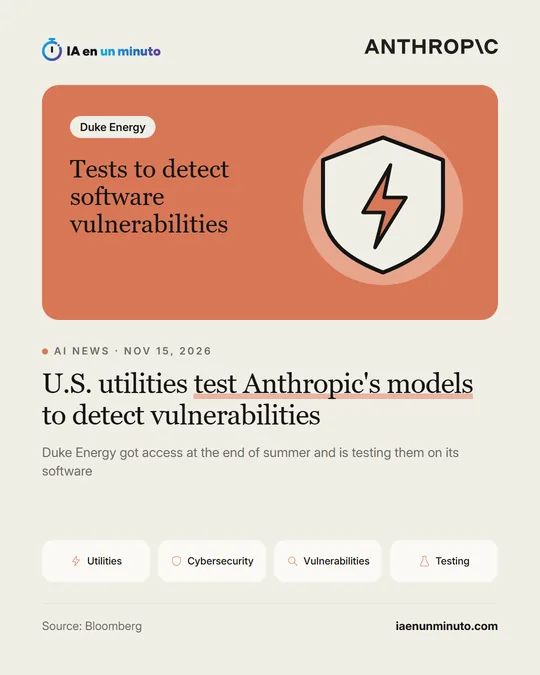
U.S. utilities like Duke Energy test Anthropic's advanced models to detect software vulnerabilities
IA en un minuto newsroom · Editor: Jon Elgezabal
In 30 seconds
Duke Energy and other power companies in the United States are trying out Anthropic's advanced AI to spot security holes in their programs, Bloomberg reports. Anthropic let them in at the end of summer, and anyone wanting the less limited versions must pass its screening and a Government check. Mythos only reached a small group this year, and the power companies are uneasy about what it costs.
Several electric utilities in the United States, Duke Energy among them, are testing Anthropic's advanced models to find vulnerabilities in their software, Bloomberg reports. Access comes after the sector spent months asking both the AI company and the U.S. Government for it.
According to Martin Strasburger, who heads security at Duke Energy, one of the country's largest energy groups, Anthropic allowed utilities to use its advanced AI tools at the end of this summer. The power companies are trying them out and building them into their cybersecurity defenses.
That access is controlled. Anthropic vets the companies that use its most powerful model to look for and fix flaws in their own systems, and those asking for the less restricted versions need the company's approval and a review by the United States Government. Mythos, Anthropic's frontier model, came out earlier this year only for a limited group of organizations under Project Glasswing, among them Amazon, Apple and JPMorgan Chase.
Then there is the cost. Strasburger explains that Anthropic has offered Mythos to some users at a subsidized rate, but that the power companies have had to pay for the technology. He described the expense of using the models as a big worry.
Anthropic is not the only one turning to the sector. In October it launched the Anthropic Cyber Mission, which offers engineers and frontier models to those who operate critical infrastructure, and Duke Energy has also joined Project Daybreak in recent months, the cybersecurity program OpenAI announced in May, according to Strasburger. Neither Anthropic nor the White House would comment to Bloomberg.
Why it matters · analysis and opinion
Until now, models able to find security flaws at great speed were in the hands of a few tech firms and banks. Their arrival at the companies that keep the power grid running changes the picture: the defense of an essential service starts to depend on a private tool whose access is decided by one company and one government. The filter makes sense, because what helps to plug holes also helps to open them, but it leaves two questions open. The first is who gets left out: if the price already worries a giant of the sector, a small utility will find it harder. The second is the pace, because attackers do not wait for any authorization. For any company, the lesson is a practical one: reviewing and fixing your own software is no longer an occasional chore.
Source: Bloomberg Línea · Written with the help of AI: how we make the news