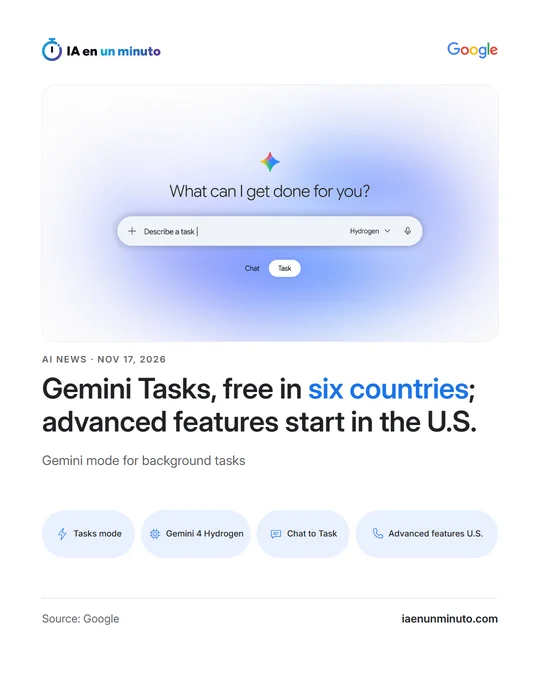
Gemini Tasks becomes free in six countries, with the advanced features starting in the U.S.
IA en un minuto newsroom · Editor: Jon Elgezabal
In 30 seconds
Google is waiving the price of Tasks, the Gemini mode that handles errands, for people in six countries, running on Gemini 4 Hydrogen. Gemini also starts phoning businesses in the United States, where it now reads text messages and forwarded emails too. Mastercard and Visa already accept its AP2 token purchases, American Express joins soon, and each user picks how much it may spend.
Google said on Tuesday that Tasks, the Gemini app mode that takes on errands and works through them by itself, no longer costs anything in the U.S. and five other countries: Australia, Canada, India, Japan and Korea. The company says the rollout begins now, reaches hundreds of millions of people and runs on its new Gemini 4 Hydrogen model. The announcement comes from Josh Woodward, Google's vice president for Labs, the Gemini app and AI Studio, on the official blog.
A set of more advanced features is starting out in the United States. Gemini can phone businesses for the user, except in Montana, Nebraska, Indiana, Louisiana and Minnesota, where calling is not offered for now. People can also send it text messages over RCS, which requires a U.S. number with a compatible carrier, and forward emails to gemini@google.com. Google also mentions new links with its password manager and with Google Pay.
For purchases, Gemini relies on the Agent Payments Protocol (AP2), which pays with digital tokens on compatible cards. Google is working with Visa and Mastercard, and American Express will follow soon. According to the company, shoppers keep earning their card's points, cashback and protections; the user decides the spending limit, and the system is built to ask for confirmation or prior approval before it presses "Buy".
On security, Google says each task runs inside a virtual machine isolated at the hardware level, reserved for the user's account and not shared with anyone else, on Google Cloud's Agent Compute Engine, with filters against prompt injection. Users can step in at any moment with further instructions.
The company admits Tasks still makes mistakes: some jobs are left unfinished or do not turn out as expected, and on certain websites Gemini gets nearly to the end and returns the screen so the user can press the last button.
Why it matters · analysis and opinion
By taking the price off Tasks, Google turns handing real chores to an assistant, such as booking appointments, comparing prices or paying, into something ordinary, and it plays its strongest card: many people's email, calendar, passwords and cards already live in its services. For shops, the change is very practical: they will start receiving calls and orders from an agent speaking on the customer's behalf, and websites that treat every bot as a threat risk being left out of those purchases. Anyone trying it would do well to set a low spending cap, check every confirmation before paying and start with jobs where a mistake comes cheap, because the company itself admits it still gets things wrong.
Official source: Google · Written with the help of AI: how we make the news
What does it mean for your business? · analysis and opinion
For businesses and freelancers in Spain and the rest of Europe, Tasks is not yet part of the announcement: Google is making it free in the United States, Japan, Korea, Canada, Australia and India and has given no dates for other markets, and business calls, text messages and forwarded email start only in the United States. Anyone with customers or suppliers in those countries should expect them to start receiving calls and orders placed by an agent on a person's behalf, and check whether their website or support line treats them like any other customer or blocks them. Our advice, for those who can try it, is not to connect customer email, invoices or company cards to a test account, to set a low spending cap and to start with jobs that involve no sensitive data, reviewing each result before relying on it, because Google itself admits that some tasks are not completed or do not turn out as expected. The prudent course is not to let it act on its own with every email until you have seen how it behaves.