Google AI Studio now builds full Android apps with Gemini, with a database and sign-in
IA en un minuto newsroom · Editor: Jon Elgezabal
In 30 seconds
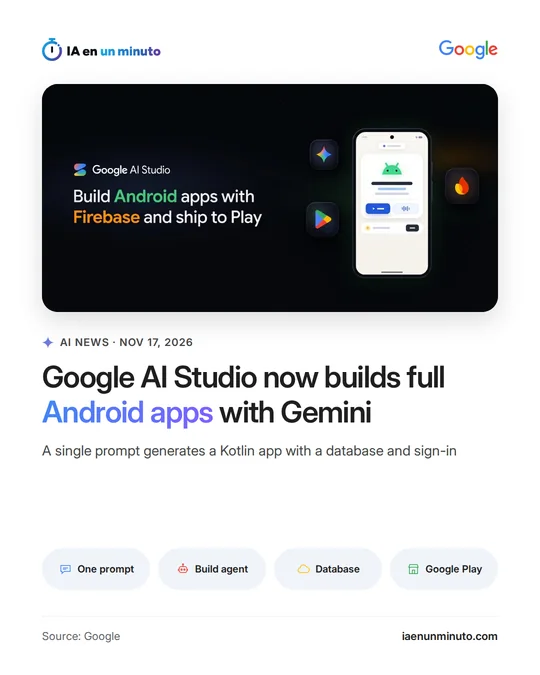
Google AI Studio turns a single request into an Android application written in Kotlin, with data stored in the cloud and access through a Google account. Build, its agent, sets up Firestore, authentication and protected calls to Gemini after asking for permission. Google Play then takes the app into a personal library so it can be installed on the phone, and the browser emulator gains high definition and sound.
Google said on Tuesday that Google AI Studio, its environment for building applications with Gemini, can now produce complete Android apps in Kotlin from one instruction, using the Gemini 4 Carbon and Hydrogen models. Until now, the Android apps coming out of AI Studio kept their data only in the local session.
When the request describes an app that has to store data, identify its users or use generative AI, Build, AI Studio's coding agent, notices and, once the user confirms, sets up the server side with Firebase. It creates a Cloud Firestore database with security rules fitted to the app's data, so what is saved syncs across devices and works offline; it configures sign-in with Google, with permissions that let each person see and change only their own documents; and it routes the calls to Gemini through Firebase AI Logic and App Check, so the API keys do not end up inside the app package.
The Android emulator that runs in the browser starts faster, offers 1200p high-definition video and plays audio in real time, which makes it possible to test voice apps or games with sound. A button in the emulator captures the screen and attaches it to the request so Gemini can change the layout. The agent also applies custom typefaces and, underneath, relies on Android's official command-line tool to create and compile projects.
To get the app onto a phone, Google has built Google Play into AI Studio: with a standard Google account, a Play account is set up in a few clicks and the app is published to the personal Google Play library, from which it installs on the phone at no cost. AI Studio produces and signs the package by itself. Google says all these features are rolling out starting today.
Why it matters · analysis and opinion
Until now, the tools that turn a description into an application tended to stop at the mock-up: something that looked good on screen but forgot its data once closed. With a database, user accounts and protected keys, the result gets closer to an app that can really be used, and that opens the door to internal tools made by people who do not code: a visitor log, an inventory, a small team's schedule. The limit lies in what cannot be seen. Security depends on rules the agent writes, and nobody reviews them if whoever builds the app cannot read them. Before putting in real customer data, it is worth checking who can read what and testing the app with an account other than your own.
Official source: Google · Written with the help of AI: how we make the news
What does it mean for your business? · analysis and opinion
This development is especially useful for freelancers, small agencies and small businesses in Spain and Latin America who want to test an app idea for Android without building a development team: an internal tool for the sales team, a catalog or a simple app for customers. Anyone who needs an iPhone app cannot use this for now, because the announcement covers only Android, and it also does not replace a developer when the project is set to grow or handles sensitive data.
Our advice is to start with a small prototype and test it on your own phone from the personal Google Play library, which has no cost. It is worth reviewing the security rules the agent generates for Cloud Firestore before adding real data, and checking that each user can only see their own documents. If the app is going to store customer or employee data, the sensible approach is to treat it like any other system in the company: inform users and decide who has access.
The main risk is trusting the generated code without understanding it. The announcement does not detail how much it costs to maintain the database and the calls to Gemini once the app has real use, so it is worth checking this before moving from testing to serving customers.