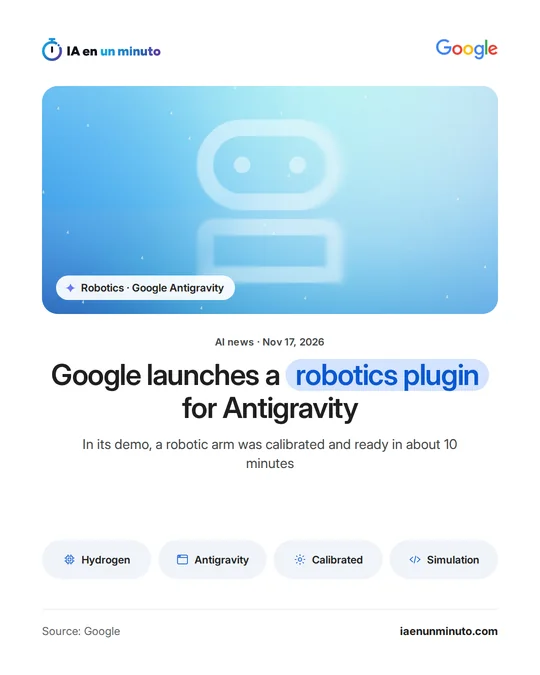
Google launches a robotics plugin for Antigravity built for its fast Gemini 4 Hydrogen model
IA en un minuto newsroom · Editor: Jon Elgezabal
In 30 seconds
Google is giving Antigravity a robotics plugin that sets up the hardware, calibrates the arm and runs trials in MuJoCo first. Hydrogen, the quick model in the Gemini 4 family, is its intended partner and reaches 58 points on an exam with a physical arm. Antigravity is reserved for people who pay for Google AI Pro or Ultra, and in the demo an arm was ready in about 10 minutes.
Google has launched the Robotics plugin for Google Antigravity today, its AI agent platform. The company's stated aim is for a robot fresh out of its box to become a working application in a single afternoon.
The plugin bundles a set of skills that Gemini uses on the developer's behalf, and it turns Antigravity into a robotics workbench. It handles hardware setup starting from a USB cable: it installs the drivers, locates the cameras, calibrates the arm and checks that it moves safely. It also runs the MuJoCo simulator inside Antigravity so ideas can be tried before the real robot is touched, relies on Gemini's grasp of space to locate objects, plan how to pick them up and control the robot, and generates the code for the controller and the simulation.
In Google's demonstration, a developer hooks a laptop up to an I2RT YAM arm and a separate depth camera, and the arm ends up calibrated and ready to work after about 10 minutes. According to the company, a similar process works for a low-cost SO-ARM101 arm and for the FR3 Duo, an industrial model.
It is designed for Gemini 4 Hydrogen, the Gemini 4 series model that Google presented last week: much faster and with spatial reasoning. On Artificial Analysis Robotics 0.1, a test in which the model drives a real robot arm with six axes across eight tasks on a table, such as serving a drink or putting blocks in a box, Hydrogen scores 58 points, close to Gemini 4 Argon and with a cheaper price per token.
Only paying subscribers to Google AI Pro or Ultra can use Google Antigravity. The plugin is installed from within Antigravity, under Customizations, by searching for Robotics in the Build With Google section. Hydrogen can also be used in the Gemini API, as gemini-4-hydrogen, and in Google AI Studio.
Why it matters · analysis and opinion
Setting up a test robot has always taken more hours of integration than of ideas: drivers, calibration, simulator and control code, each piece on its own. Google wants an agent to do that work and ties it to its own paid ecosystem, with a cheap model so that leaving it running all day makes sense. The demonstrations come from the company itself and use specific arms; it remains to be seen how it copes with other hardware and in settings less tidy than a test table. For an engineering firm, a university lab or a small automation company, the appeal lies in faster prototyping: trying things first in simulation and taking only what works to the real arm, without treating as safe a movement nobody has reviewed.
Official source: Google · Written with the help of AI: how we make the news