Microsoft adds AI agents and security tools to Edge for Business
IA en un minuto newsroom · Editor: Jon Elgezabal
In 30 seconds
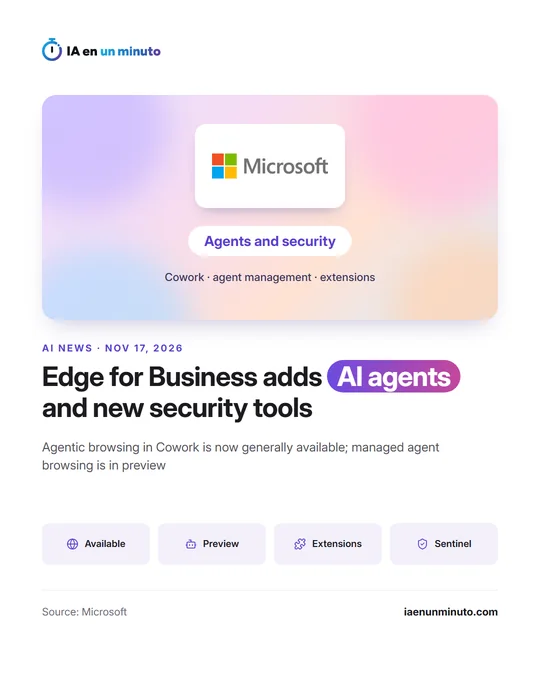
Microsoft is using Ignite 2026 to bring AI agents and more protection controls to its corporate browser. Cowork now moves through several sites to finish long errands, with a Copilot license and pay-per-use billing, while the variant managed by IT is still being tested. Extension safety, open to everyone, scores the risk of each extension, and three other defenses arrive only in preview.
Microsoft presented a set of updates for Edge for Business, the edition of its browser built for companies, at its Ignite 2026 conference on Tuesday, bringing AI agents and new security tools. At the previous Ignite, a year ago, the company had launched AI browsing with Copilot inside this same browser as a test.
That agent-driven browsing now belongs to Cowork and is open to every customer: it can take on tasks of several steps spread across different websites on the user's behalf, and it opens from the side pane, the new tab page or the web. It calls for a Microsoft 365 Copilot license with usage-based billing switched on. Microsoft says Cowork returns control to the user when it is time to sign in or pay, asks for permission before delicate actions and can be watched or halted at any moment. Another feature, Skills recorder, captures a process the user completes once and turns it into a Cowork skill that can be used again and shared with the team; it will reach preview before the end of the year, with the same license.
For the IT department, managed agent browsing makes it possible to require agents from Microsoft and other vendors to work inside Edge for Business. Each agent opens its own window, with a Microsoft Entra agent identity, and moves within the user's permissions and the organization's policies. It is in preview and needs Microsoft 365 E5. The company adds that it is working so any agent can handle the most common web tasks in its browser while spending fewer tokens: in its first internal tests it reports average consumption 30% lower.
On security, Extension safety now gives every customer with a Microsoft 365 license an inventory of the organization's extensions, with risk scores from Spin.AI and Akamai for each extension and each version. Three more features arrive in preview: Extension leak control, which with Microsoft 365 E3 stops extensions installed by the organization from reading what protected pages contain; a native connector that sends the browser's security events and audit logs to Microsoft Sentinel, with a Sentinel license; and Microsoft Entra Global Secure Access, which with Microsoft 365 E7 opens the company's private web apps from the Edge work profile, with no separate VPN client.
Microsoft also claims that Edge for Business is now the most widely used enterprise browser in the world. It bases this on the worldwide share of browser minutes on Windows machines at organizations with over 1,000 employees, and the post does not say who carried out that measurement.
Why it matters · analysis and opinion
The news lies less in a browser shipping an agent than in who controls it. Until now, every assistant that opens websites on its own was a door the IT team struggled to watch; Microsoft proposes that they all go through a browser with the same policies, identities and logs it already applies to people. For anyone already working with Microsoft 365, that makes it possible to try agents without opening a new way in. The flip side is the bill: each feature needs its own license, from Copilot with pay-per-use billing to various enterprise plans, and much of it is still in preview. Before switching it on, it is worth checking which licenses staff already have and starting with low-risk tasks, with no payments or customer data.
Official source: Microsoft · Written with the help of AI: how we make the news